
Europe’s Family Financial Education Problem
Across Europe, financial education often begins too late and rarely becomes a family habit. YOBY turns money skills into a shared, playful experience built around everyday choices.
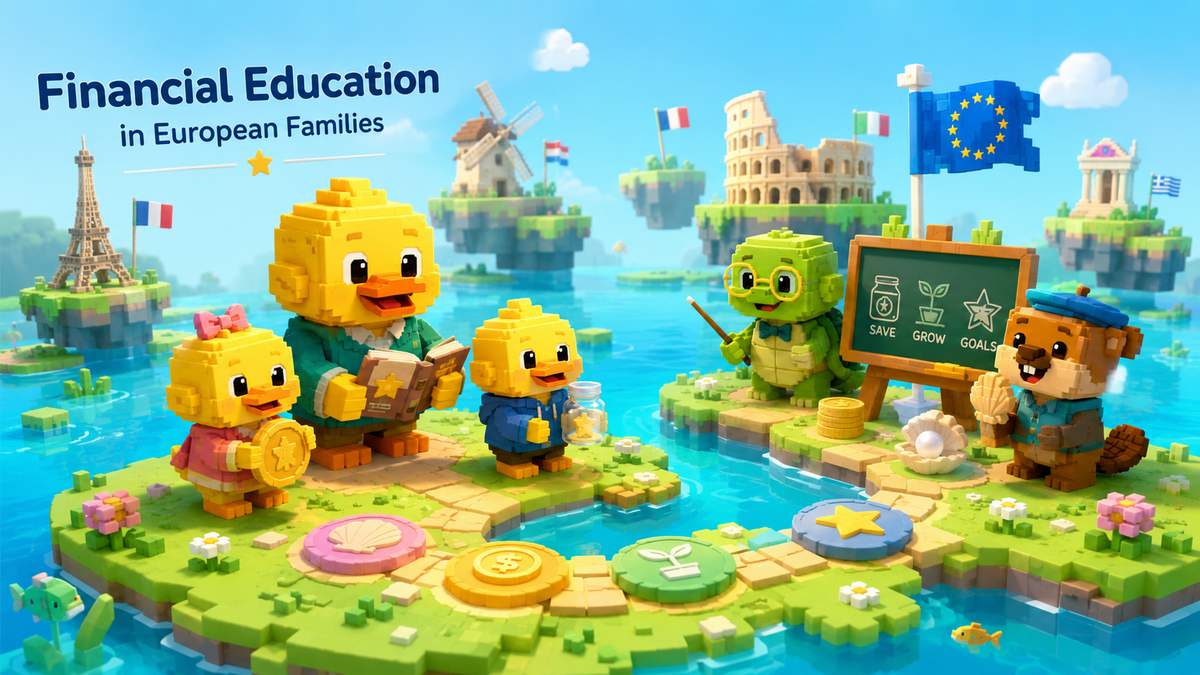
Financial Education, Families, Children, Europe, Fintech, EdTech, YOBY
Across Europe, the evidence points to a sobering conclusion: financial education still arrives too late, too unevenly, and too often outside the home. At EU level, only 18% of citizens display a high level of financial literacy, while 64% are in the middle and 18% remain at a low level. On basic knowledge questions, the picture is hardly reassuring: 45% of EU adults correctly answer a question on interest rates, 65% on inflation, just 20% on bond prices, 66% on the risk-return trade-off, and 56% on diversification. In the OECD/INFE international survey, the average adult financial literacy score across participating countries and economies was 60 out of 100, and only 34% reached the minimum target score; just 42% could answer a compound-interest question correctly, only 26% compared financial products across providers, and just 24% sought independent advice when purchasing financial products and services. Digital vulnerabilities are layered on top of this: only 29% reached the minimum target on digital financial literacy, and 15% reported having been victims of at least one type of financial fraud or scam.
For families, this is not an abstract policy issue. It is the difference between teaching a child what saving means before the first digital purchase, or leaving that lesson to a bank app, a buy-now-pay-later prompt, an influencer, or a crisis. OECD evidence from PISA 2022 is unusually clear on this point: students who discuss saving or purchasing decisions with their parents are more financially literate, and 68% do so at least once a month across participating systems. Yet the same OECD evidence also shows that only about two in three students have been exposed to school tasks exploring financial issues, and socio-economic background still accounts for a meaningful share of performance differences. In other words, money learning in Europe is still too dependent on what kind of family one is born into.
That is why the state of family financial education in Europe can reasonably be described as troubling, and in some contexts almost tragic. The tragedy is not simply that many adults do not know enough. It is that a great deal of financial socialisation still happens through silence, improvisation, anxiety, and unequal exposure. Some countries have built serious national strategies and school programmes. Some families do save for their children, give pocket money, and talk about purchases. But the broader European pattern remains fragmented: basic budgeting is inconsistent, advanced concepts are rare, and the connection between home practice, school learning, and digital life is often weak.
For a family-facing platform such as YOBY, this matters enormously. YOBY presents itself not as a trading app or a finance course, but as a digital space where kids and parents “build healthy financial habits — together, every day”, using a private family space, short quests, mentor characters, and symbolic currencies that make learning feel playful rather than scholastic. That positioning is not cosmetic. It fits the strongest strand in the evidence: children learn money partly through instruction, but very deeply through repeated family interaction, shared language, and low-stakes practice. Tools like YOBY will not solve structural inequality on their own. But in Europe’s current landscape, a family-first, habit-based, playful tool is not peripheral to the solution. It is very close to the centre of it.
Europe has a household problem, not only a curriculum problem
Europe has spent years building competence frameworks, strategies, and policy language around financial literacy, and that work matters. But the household diagnosis remains severe. The European Commission’s own evidence shows both low aggregate literacy and wide disparities between member states. Only four member states had more than one quarter of citizens scoring highly in financial literacy in the 2023 EU survey, with the Netherlands among the leaders. The same evidence points to persistent gaps by age, income, education, and gender. OECD findings point in the same direction: many adults can define inflation, but far fewer can apply compound interest, compare products, or seek independent advice. The result is a public that may feel experienced in spending, but is often underprepared for planning, comparison, and long-term decision-making.
This matters because financial education is cumulative. A teenager who learns to compare prices, question a recurring subscription, or understand why money set aside today matters tomorrow is not simply accumulating facts. That teenager is building habits, emotional responses, and a mental model of trade-offs. PISA 2022 found that students with stronger financial literacy were 72% more likely than low performers to save money and 50% more likely to compare prices in different shops before buying something. The same OECD work stresses that parent interaction is not a side issue: students who discuss spending decisions with their parents weekly or monthly perform better in financial literacy. Europe therefore faces a dual educational problem: many schools are not doing enough, and many families are doing what they can without a common language, a clear progression, or practical tools.
Put differently, the weakness of family financial education is not just that some children never hear about budgets or savings. It is that millions hear about money only episodically: when there is no cash left, when a purchase is denied, when debt becomes stressful, or when a parent says “we can’t afford it” without ever showing how decisions are made. Across EU countries, disadvantaged students score far below advantaged peers in financial literacy; the Joint Research Centre notes an average gap of 92 points across EU countries cited in its synthesis. That is not simply a school-performance issue. It is an intergenerational transmission issue.
Country and language-area analysis
Italy. Italy remains one of the clearest cases where the family dimension is crucial because the adult baseline is weak. In the OECD/INFE 2023 survey annex, Italy’s adult financial literacy score was about 53.3 out of 100, and only about 16.6% of adults reached the minimum target score. The European Commission’s 2026 country report, drawing on the 2023 Eurobarometer, says 18% of Italians have a high level of financial literacy, 64% a medium level, and 19% a low level. Among 15-year-olds, Italy scored 484 points in PISA financial literacy, below the OECD average of 498; 18% of students did not reach the baseline level, and only 5% were top performers. The encouraging part is that family discussion clearly matters: over 80% of Italian students reported talking monthly with parents about online shopping and money for things they wanted to buy, and students who discussed online shopping with parents performed 21 points better than those who never did. The worrying part is what is missing: only 9% reported having learned compound interest at school and still knowing what it means. Italy has finally strengthened school provision, with a 2024 law introducing financial education into the curriculum as part of civic education, but the country is still playing catch-up with a long-standing family and school gap.
The UK, Ireland, and English-speaking Europe. Here the evidence is mixed, but the family story is unmistakable. In the UK, the Money and Pensions Service found that 71% of children and young people received regular money through pocket money or work, yet only 35% of parents or carers set rules about how that money was spent, and only just over half felt confident talking to children about money. More recent MaPS work also shows that children and young people in low-income households are significantly less likely to have the foundations of good financial wellbeing. Financial fragility at home is equally visible in adult data: the FCA’s 2024 Financial Lives survey found that 69% of lone parents had no investible assets or assets below £1,000, compared with 32% among couples with children. That is what weak family financial education looks like in practice: not merely low knowledge, but low room for rehearsal, planning, and intergenerational calm.
Ireland looks stronger on adult literacy but still carries real household stress. The CCPC’s 2023 national survey, built on the OECD toolkit, gave Ireland an overall financial literacy score of 14 out of 20 and found that 58% of people were satisfied with their current financial situation. But one in three respondents said they were “just getting by financially”, and one in eight could cover costs for a month or less in the event of an income shock. The CCPC’s deeper population-group analysis also found significant disparities in financial behaviour and financial knowledge and highlighted the groups that would benefit most from additional support. The same research notes that people living with family and certain household types show different outcomes, which is a reminder that the family remains a real economic institution, not just an emotional one. For Malta, a smaller but relevant English-speaking EU area, the OECD/INFE annex indicates comparatively strong adult results, with a score of about 67.7 out of 100 and roughly 45.5% reaching the minimum target, but recent family-specific national evidence is thinner. In English-speaking Europe, then, the challenge is less a total absence of literacy initiatives than a mismatch between what parents believe they should do and what they feel equipped to do consistently.
France and Francophone Belgium. France’s adult financial literacy results are around the middle of the European pack in the OECD/INFE annex, at about 62.0 out of 100, with roughly 38.7% of adults reaching the minimum target. But France has been more systematic than many countries in turning financial education into a public programme. The Banque de France reports that France has had the EDUCFI national strategy since 2016 and that, in the 2023-2024 school year, 100% of Year 9 students would obtain the “EDUCFI” passport after completing the relevant sequence. That is a serious institutional achievement. It does not mean that every French family now speaks money fluently at home, but it does mean the state has stopped treating financial education as a niche extra.
Francophone Belgium is harder to assess cleanly because the data architecture is fragmented by community and recent family-specific national surveys are limited. But the available Belgian evidence is telling. A Wikifin family survey found that three parents in four save money for their children, more than 80% of children already have a savings account from age six, and two parents in three give pocket money. At the same time, 70% of children did not know approximately how much their parents earned. That is almost a perfect summary of the European contradiction: families are often willing to organise money for children, but much less willing or able to explain money to children. Newer Belgian evidence suggests the broader adult challenge persists. In 2026, Wikifin reported that only 52% of Belgians draw up a budget and that nearly 10% of 18-24 year-olds who do not budget say they do not know where to start. Belgium’s 2026 country report also shows a financial literacy composite index at the EU average, not above it. So even where savings habits exist, conversational and practical habits remain shakier than they should be.
Spain. Spain offers one of the most useful examples of both the problem and a credible policy response. In the OECD/INFE annex, Spain’s adult score is about 63.9 out of 100 and just over 39% reach the minimum target. Among students, Spain scored 486 points in PISA financial literacy, again below the OECD average of 498; 17% did not reach baseline proficiency and only 5% were top performers. Yet Spain also provides unusually concrete evidence on the value of structured education. Its national financial education strategy dates to 2008, and OECD’s country factsheet notes that a randomised controlled trial involving roughly 3,000 students in 78 schools showed that a 10-hour financial education course improved students’ financial knowledge, financial behaviour, and attitudes toward saving; it also increased the share of students who talked about economics with their parents. Family discussion is plainly active in Spain: 84% of students reported monthly conversations with parents about money for things they wanted to buy, 76% about their own saving decisions, and 76% about online shopping. But the teaching gap remains striking: only 21% reported learning about exchange rates and 21% about compound interest and still knowing what those terms meant. Spain therefore looks like a country that understands the problem, has policy traction, but still has not normalised deeper financial understanding across all households.
Germany and Austria. Germany is the strongest language area in this group on adult financial literacy, but not as comfortable as the headline might suggest. In the OECD/INFE annex, Germany’s adult score is about 76.0 out of 100, and roughly 75.5% of adults hit the minimum target score, making Germany one of the strongest performers in the participating sample. Yet the OECD’s dedicated 2024 report on Germany shows why high averages can conceal serious vulnerabilities: only 55% of adults feel confident about their retirement plans, 25% cannot cover living expenses for three months if they lose their main income source, and 65% know that cryptocurrencies are not legal tender. The same report says that more evidence is needed on young people’s needs, and that school provision could be better coordinated. Germany has moved decisively by launching a federal Financial Literacy Initiative and developing a national strategy across generations, but the German case is a useful warning against complacency: superior average literacy does not automatically produce resilient family practice.
Austria is not in the OECD/INFE adult-country list used above, but the European Commission’s 2026 country report provides a strong official snapshot. It says 28% of Austrians have a high level of financial literacy, 50% a medium level, and 22% a low level, slightly better than the EU average. Austria also has a national financial literacy strategy launched in 2021, and the Commission highlights its emphasis on sound decision-making, preventing over-indebtedness, responsible planning, access to quality education, and more effective initiatives. This is the picture of a country that is comparatively well organised. Yet even here, the language of the report is revealing: “some challenges remain.” They do indeed, especially in translating a national strategy into regular family conversation, practical repetition, and habit formation from childhood onward. Recent household-level family-survey evidence for Austria is less rich than for Italy, Spain, or Belgium, so one has to be modest in the claim. But the institutional direction is clear.
Portugal and Dutch-speaking Europe. Portugal is one of the more serious and self-aware cases. The Portuguese supervisors’ 2023 survey results, published in 2024, place Portugal 13th out of 39 participating countries on the global financial literacy indicator, above the international average and above average on financial attitudes and behaviours; Portugal also ranked seventh on financial well-being, with 51.4 points. At the same time, Bank of Portugal officials have explicitly described national results as showing “still insufficient” financial literacy. That combination is important: Portugal is neither a laggard nor a success story that can relax. It is a country with significant policy maturity, including a Digital Financial Literacy Strategy for 2023-2028, but still a clear sense that families need more support in managing an increasingly digital money environment. The strongest Portuguese lesson may be that financial literacy is no longer only about cash, banks, and savings; it is also about fraud, interfaces, and digital habits at home.
The Netherlands is the standout Dutch-language case. The Commission’s 2026 country report says financial literacy is “very high” in the Netherlands, notes a national strategy in place since 2008, and reports that 43% of the Dutch public have a high level of financial knowledge, versus 26% in the EU, while only 18% have a low level. Just 8% report discomfort using digital financial services, compared with 23% in the EU. The same report stresses that the current Dutch strategy is based on the EU/OECD competence framework and aims to prepare people “from a young school age” to take financially sound decisions. That is what a more mature ecosystem looks like: not only adult knowledge, but consistent institutional reinforcement from childhood. Dutch-speaking Belgium is less cohesive as a case. The Flemish community participated in PISA financial literacy, but recent full-family Belgium-wide evidence remains patchy and often older. Here the contrast with the Netherlands is instructive. Shared language does not guarantee shared outcomes. Policy continuity, educational integration, and trusted public infrastructure also matter.
What the cross-country evidence suggests
The first lesson is that Europe’s family financial education problem is not uniform, but it is continental. Germany and the Netherlands are stronger in adult financial literacy. Italy is much weaker. Spain, France, Portugal, and Ireland sit somewhere in between, each with real progress and real gaps. Belgium presents a mixed and community-fragmented picture. But across all of them, the same structural pattern returns: where institutions are strong, outcomes tend to be better; where family conversation is frequent and practical, children do better; where both are weak, literacy becomes a matter of luck and class inheritance.
The second lesson is that “education” cannot be reduced to curriculum insertion. The OECD’s student evidence shows that discussing purchases, saving, and online shopping with parents is associated with better outcomes. National evidence from Spain and UK surveys reinforces the same point: home routines, rules, and confidence to talk matter. But Europe still treats money learning unevenly, as though knowing how to analyse a poem were educational while knowing how to read an invoice, compare subscription costs, or understand compound interest were merely practical. That divide is intellectually outdated and socially expensive.
The third lesson is that the digitalisation of household finance has raised the stakes. Families are no longer introducing children to money gradually through coins, envelopes, and weekly pocket money alone. They are introducing them into a world of contactless payments, app dashboards, online shopping, in-game purchases, BNPL prompts, phishing, and algorithmic persuasion. Belgium’s 2026 survey already shows rising use of smartphone payments and BNPL, and the Netherlands’ high comfort with digital finance shows the other side of the coin: digital confidence can be a strength, but only if the habits underneath are sound. Europe’s family financial education problem has therefore become more urgent, not less, precisely because daily money decisions are becoming frictionless.
Why the gap persists at home and in school
One reason is simple: many parents are unsure how to teach what they themselves were never formally taught. The UK evidence that only just over half of parents feel confident talking to children about money is not a British oddity. It is probably a broader European condition that is merely better measured there. Another reason is discomfort. Families may happily save for a child or hand over pocket money, but feel awkward discussing salary, debt, budgeting tensions, or trade-offs. Belgium’s finding that 70% of children do not know roughly what their parents earn is revealing not because children need exact numbers, but because it exposes how often money remains administratively managed yet culturally unspoken.
Schools do not fully compensate. Italy’s PISA note shows that fewer than one in five students had learned about diversification or exchange rates and still knew what they meant, and only 9% said the same for compound interest. Spain’s school exposure is better on basic terms such as wages and budgets, but still weak on exchange rates, return on investment, and compound interest. Across OECD systems, only around two in three students report exposure to school tasks exploring financial issues. Europe therefore still tends to teach money either too superficially or too late. It often teaches terminology without rhythm, and caution without practice.
There is also a social reason. Financial education at home is easier when the household has some slack. It is easier to teach saving when there is money to set aside, easier to teach planning when bills do not arrive as shocks, easier to talk calmly about trade-offs when one is not living them in fear. The FCA’s lone-parent data and Ireland’s “just getting by” findings are useful reminders that family financial education is inseparable from family financial conditions. That does not mean education is pointless. It means education must be designed for real households, not idealised ones. It must be low-friction, repeatable, emotionally bearable, and embedded in ordinary family life.
Why tools like YOBY belong in the solution
The strongest evidence in this field points toward a very specific kind of intervention: one that is early, recurring, family-based, practical, and emotionally light enough to be used repeatedly. That is exactly where tools like YOBY make sense. On its own site, YOBY describes itself as a digital world where kids and parents build healthy financial habits together every day, through a private family space, mentor characters, short quests, and symbolic currencies for goals, saving, and good habits. It is “learning by doing, not studying”, and it is designed specifically for minors and parents rather than retrofitted from adult finance products. That is not just attractive branding. It is a design logic aligned with what the data says families actually need: scaffolding for conversation, repetition, and shared action.
If Europe’s problem were only the lack of information, a PDF or a school leaflet would be enough. But the problem is bigger than information. It is about habit formation, emotional tone, intergenerational confidence, and the normalisation of money talk before high-stakes decisions arrive. YOBY’s family-first and playful framing is therefore valuable precisely because it lowers the threshold for entry. It gives parents and children a shared environment in which to explore goals, saving, choices, and consequences without turning the household into a classroom or the child into a miniature investor. In a continent where the evidence repeatedly shows that parent interaction matters and that schools alone are insufficient, this kind of tool is not a luxury add-on. It is a credible bridge between policy ambition and family reality.
No honest editorial should claim that one product can cure Europe’s deep inequalities in income, confidence, school quality, and financial access. But that is not the right standard. The right question is whether a tool helps families do more of what the best evidence says works. On that test, the answer is yes. Europe needs stronger curricula, better teacher support, more coherent national strategies, and robust consumer protection. It also needs children and parents to speak about money more often, earlier, and with less anxiety. That is why tools like YOBY can be part of the solution: not because they replace institutions, but because they help institutions finally enter the home.
Key sources
- OECD/INFE, OECD/INFE 2023 International Survey of Adult Financial Literacy and Annex D data tables.
- OECD, PISA 2022 Results Volume IV; OECD factsheets for Italy and Spain; OECD brief on the role of parents in student financial literacy.
- European Commission and related EU publications on financial literacy, including the 2023 Eurobarometer analysis cited in EU reports and the 2023 European Financial Stability and Integration Review.
- European Commission 2026 Country Reports for Italy, Austria, the Netherlands, and Belgium.
- CCPC Ireland, Financial Wellbeing in Ireland: Financial literacy and inclusion in 2023 and follow-on disparity analysis.
- FCA, Financial Lives 2024; Money and Pensions Service, children and young people financial wellbeing and capability research.
- Banque de France and EDUCFI reporting on France’s national financial education strategy and school passport.
- Bank of Portugal and Portuguese supervisory authorities on the 2023 Portuguese financial literacy survey and digital financial literacy strategy.
- Belgium’s Wikifin and FSMA material on family money management and current budgeting behaviour.
- YOBY official website for product framing and family-learning positioning.