The YOBY Roadmap: A World That Grows With Us
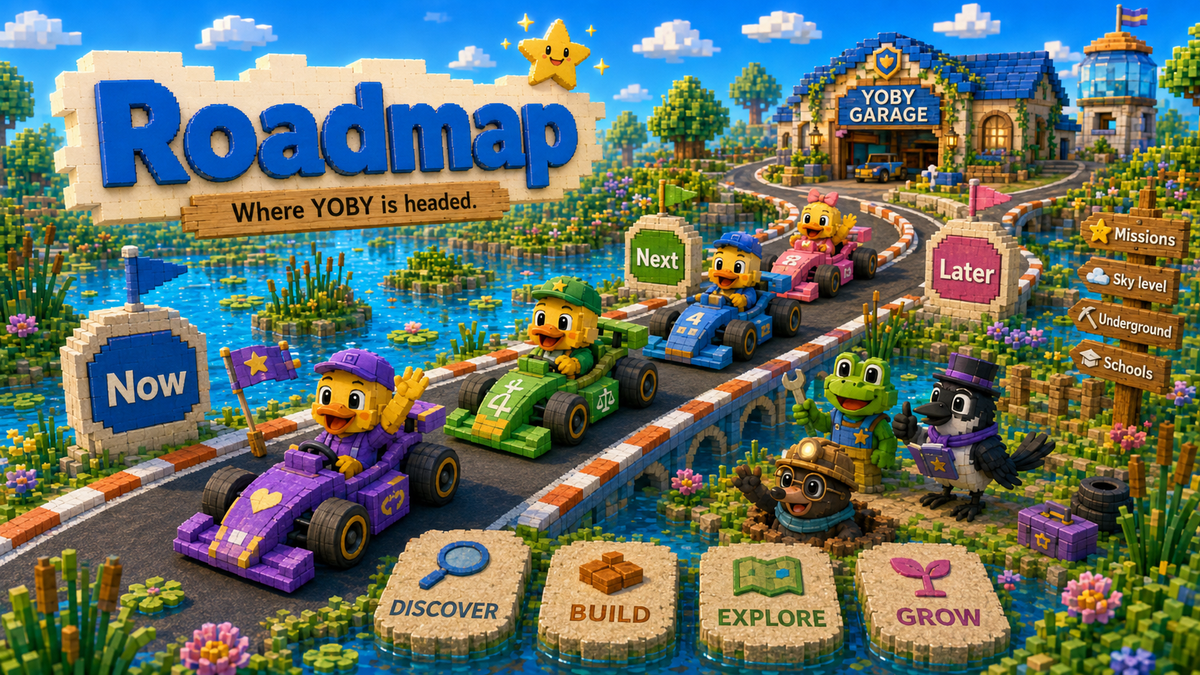
YOBY’s roadmap shows how the family pond is growing: more missions, deeper progression, sky and underground levels, safer family features and future school programmes.
There is a peculiar thing about childhood: almost everything that matters later in life begins there in a form so small that we barely recognise it. A first promise teaches responsibility. A first disappointment teaches patience. A first object saved for, coin by coin, teaches time. Money enters this world quietly. It may be a few coins in a pocket, a birthday gift, a toy that costs more than expected, the mysterious observation that adults sometimes say yes and sometimes say no. Yet behind those tiny events already stand nearly all the great questions of economic life: What do I want? What do I need? What can I afford? What should I postpone? What is something worth to me? What happens if I choose this instead of that? YOBY begins there, not with finance as an academic subject, but with money as one of the languages through which human beings make choices. The pond is simply the first place in which that language becomes visible.
YOBY was therefore never conceived as a course that children eventually finish. Courses have a final page. Childhood does not. Families do not. Our relationship with money certainly does not. A seven-year-old who wonders whether to spend ten shells at the market and a thirty-seven-year-old who wonders whether to buy a house are separated by decades, vocabulary and scale, but the structure of the decision is strangely familiar. Both must choose between the present and the future. Both must distinguish desire from possibility. Both must accept that choosing one path closes another. Once we understood that, the horizon of YOBY changed. We were no longer designing an educational game for one age group. We were beginning to imagine a world capable of growing older with the people who inhabit it.
NOW: the world already exists
That future does not begin with an empty diagram and a collection of promises. YOBY already exists as a three-dimensional world in which families explore through their own duck characters, moving through ponds, streams, villages and spaces designed around discovery rather than instruction. Children and adults can inhabit private family ponds, meet characters, answer quizzes, collect objects, take part in activities and move through an economy made deliberately symbolic. Shells, seeds and stars are not representations of real financial assets and are not designed to imitate speculative markets. They are the first alphabet of value inside the world, objects with which children can experience possession, scarcity, saving, spending, patience and choice long before anyone needs to place those experiences beneath intimidating financial terminology.
There is already a market in YOBY, and that matters more than it may first appear. Every Tuesday, Loris arrives with his boat, bringing with him the wonderfully ancient human problem of exchange. Something is offered. Something has a price. Something else is desired more. The child discovers that possessing enough to buy something does not automatically answer the question of whether it should be bought. Prices become visible, value becomes debatable, choices acquire consequences. Elsewhere in the world there are fragments to discover, collections to complete, places to explore, quizzes that turn financial concepts into situations and characters that can transform explanation into conversation. There is play for its own sake too, because a world that exists only to teach soon becomes a classroom wearing feathers. YOBY has its arcade experiences, its races, its exploration and its secrets because pleasure is not the enemy of learning. Very often, it is the road by which learning arrives unnoticed.
The world already speaks seven European languages: English, Italian, French, Spanish, Portuguese, German and Dutch. That multilingual structure is important because money is universal while financial culture is not. The word for saving may translate easily, but attitudes towards pocket money, banks, cash, debt, independence and family responsibility do not always cross borders intact. YOBY can therefore remain one world without pretending Europe is one household. The pond may be recognisable everywhere while the conversations around it gradually learn the customs of the places in which it appears.
Above all, YOBY already treats the family as part of the experience rather than as the administrative machinery surrounding a child account. Parents can enter the pond. They can accompany. They can supervise. Teachers can open controlled access to educational activities. The child is not thrown into a public network and left to navigate strangers. The architecture begins from private spaces, invitation and adult responsibility. Even video communication is conceived around the presence and control of adults. We do not consider these things accessories to the game. They are part of what the world is.
This is YOBY now: not an idea waiting for technology, but a world waiting for time.
The next years: when choices begin to leave traces
The next stage is not simply to add more things. It is to make the world remember more of what happens inside it. Today a child can make a choice. Tomorrow that choice can begin to leave a footprint. Goals, habits, completed missions, postponed desires and family activities can gradually alter the landscape itself. Instead of reporting progress through an abstract wall of scores, YOBY can allow progress to become geography. A family that learns, saves, waits, completes challenges and pursues goals together should not merely accumulate points. Its pond should tell the story.
The mentor characters will grow with this idea. Their questions can become less about identifying the textbook answer and more about confronting situations in which several desires compete. A player may understand that saving is useful, yet still desperately want the object in front of them. That tension is not a failure of financial education. It is financial education. Adults live inside such tensions every day. YOBY can make them small enough to explore safely and concrete enough to remember. Some missions will remain within the game, some will invite observation of the real world, and some will belong to the family rather than to the child alone. The goal is not to make home life into homework. It is to make the subject of money ordinary enough that it can be spoken about without ceremony.
Then the world can extend vertically. Above the ponds lies the Sky, because human beings have always placed distant things above the horizon. A child can understand wanting something today. Wanting something six months from now is much harder, because six months is an abstraction. YOBY can give distance a shape. A goal can become a destination that cannot be reached in a single afternoon. Progress becomes movement. Patience becomes altitude. Saving ceases to be the act of not spending and becomes the act of travelling towards something.
Below the ponds lies the opposite lesson. The Mole's world is underground because many costs are underground too. We notice the purchase price because it stands in the sunlight. We notice the subscription later, the repairs later, the replacement parts later, the maintenance later, the energy later. Children discover very early that objects cost money, but much of adult life is spent discovering that ownership continues to cost money after the object has already become ours. In the underground world, this hidden layer can become visible. A toy may have batteries. A pet has food. A vehicle has maintenance. A house has a roof that eventually remembers gravity. The vocabulary may become more sophisticated with age, but the intuition can begin with a tunnel and a Mole who knows what the surface has forgotten.
The school is not another world
Schools can enter this ecosystem without converting it into a digital textbook. A teacher can use quizzes, missions and structured paths while the child continues to encounter them inside the same world used for exploration and play. YOBY can provide educational material, but schools should also be able to bring their own questions and activities. A teacher in France, Italy or the Netherlands may want to emphasise different examples, different terminology or different parts of the curriculum. That is not fragmentation. It is what education has always done when it works well: take a general idea and give it a local voice.
This creates a triangle that is unusually difficult to achieve with traditional financial education. The school can introduce a concept. YOBY can make the concept experiential. The family can encounter the same idea later without opening a schoolbook. A child who has discussed saving in class may meet a character facing a similar decision in the pond and then, days later, hear a parent talking about a real family goal. The three events do not need to be identical. Their power lies precisely in their difference. One explains. One simulates. One lives.
There are roads we will never take
Any serious roadmap must eventually describe not only the future it seeks, but also the futures it rejects. Technology makes many things possible, and markets have a habit of converting possibility into temptation. YOBY will have temptations too. A world inhabited by children and families could be enormously attractive to advertisers. A game capable of observing thousands of choices could produce extraordinarily detailed behavioural profiles. A system with currencies and rewards could be pushed towards gambling-style mechanics. A social world could be opened to strangers in the name of growth. Safety features could become premium advantages. We know these roads exist. We simply do not intend to travel them.
There will be no advertising inside the children's experience. Not at launch, not after a million users, not because somebody discovers an ingenious new euphemism for advertising. Children are not units of attention to be rented by the thousand. YOBY will not learn that a child wants a bicycle and then sell the right to exploit that desire. It will not place a commercial message between a lesson about saving and the object being saved for. It will not build behavioural advertising profiles from children's choices. If the economics of the world ever require us to choose between protecting that principle and earning more money, then the principle must win, because otherwise the lesson YOBY would teach about money would contradict the very reason for its existence.
Partnerships may exist, and educational sponsorships may exist, but sponsorship must never be allowed to disguise itself as persuasion. A museum might help create a collection. A foundation might fund a financial education experience. A bank might support an activity about saving. An organisation can be acknowledged for having made something possible. None of these things gives it the right to target a child, personalise a commercial message, build a sales funnel or place a purchase request inside the experience. A sponsor may help build a bridge in the world. It does not own the children who cross it.
We will not sell family data. We will not build an open social network for children. We will not optimise an infinite feed to make departure psychologically difficult. We will not create loot boxes, speculative currencies, cashable chance rewards or gambling mechanics and then call them financial education. Randomness can produce surprise and delight inside a game, but financial risk must never be taught with the emotional machinery of a slot machine. We will not make safety a premium product. There will never be a cheaper version of YOBY in which children are less protected because their parents pay less. Privacy is not downloadable content. Protection is not an upgrade.
Nor are we building a trading terminal for children. YOBY may one day teach what investing means, why diversification exists, how compound growth works and why higher potential returns generally travel with higher uncertainty. These are essential parts of financial literacy. They are not an invitation to turn childhood into speculative activity. Education can explain markets without transforming a child into a customer of them.
And YOBY itself does not need to become a bank. In the distant future it may connect to real financial infrastructure through regulated partners, because eventually a player who once dealt with shells will have a salary, a bank account and bills. But there is a profound difference between helping someone understand money and holding their money. A bank can provide accounts, payments, savings products or credit. YOBY can remain the place where the person understands what those instruments mean and why they might or might not need them. The distinction protects both the educational purpose and the player.
Perhaps most importantly, YOBY must never grow into an ordinary financial dashboard decorated with ducks. That would be the easiest failure to imagine. The child becomes older, so the pond disappears, replaced by charts. The characters disappear, replaced by categories. The world becomes the same software adults already tolerate, except that somewhere in the corner there is a yellow bird reminding us that once it was fun. We do not want that future. The difficult and far more interesting problem is to discover how a playful financial world can mature without surrendering imagination.
Then the children become teenagers
This is where the roadmap changes scale. A child may worry about buying a toy. A teenager may have a bank card, a phone contract, transport costs, streaming subscriptions, clothes, concerts, a first trip without parents, online purchases and perhaps their first earnings. The numbers become larger, but something else changes too. Money begins to represent independence.
YOBY at that age must become less protective of decisions and more interested in consequences. Monthly budgets become meaningful because months begin to contain commitments. Recurring costs become visible because subscriptions accumulate. Fraud and scams stop being theoretical because teenagers inhabit digital commerce. Work becomes connected to income. Income becomes connected to taxation. Borrowing introduces the uncomfortable discovery that money can travel backwards through time, bringing the future into the present at a price.
The market in YOBY can mature accordingly. Prices can fluctuate. Decisions can unfold over weeks. The player can discover that being able to pay for something and being able to afford it are not identical states. The Sky can contain more ambitious goals. The Underground can become deeper. Parents, meanwhile, need not remain spectators. They can receive their own missions and decisions. A sixteen-year-old may be considering an expensive computer while a parent considers whether to replace an old appliance. The objects are different, the amounts are different, but beneath them lies the same architecture of choice: urgency, alternatives, time, value and consequence.
This is when YOBY can cease being a game adults supervise and become a world generations genuinely share.
The first salary
Then comes one of the great revolutions of ordinary life. For the first time, money arrives not primarily from parents, gifts or occasional tasks, but from work. A salary appears. Suddenly a number that seemed large at the beginning of the month develops the astonishing ability to become small.
The young adult enters a financial universe that childhood only hinted at. Rent. Deposits. Utilities. Taxes. Insurance. Emergency funds. Credit. Interest. Saving. Pensions. Contracts. Perhaps university debt in one country, perhaps different obligations in another. The world becomes denser, but YOBY does not need to abandon its language in order to speak about it. The Sky that once contained a bicycle may now contain a year abroad, a first home, a business, a journey or simply six months of financial safety. The Underground that once explained the batteries in a toy may now contain fees, maintenance, insurance premiums and the slow accumulation of recurring obligations.
At this point the first connection with real financial services becomes possible, but it must occur in the correct order. Most financial institutions meet people at the moment a product is about to be offered. YOBY could have known the person educationally for years before that moment arrives. Not known their weaknesses. Not assembled a dossier of impulses. Known them in the only sense that matters to YOBY: as someone who has spent years learning the language of financial choice.
That reverses the usual sequence. First comes understanding. Then, perhaps, comes the product.
The person understands saving before receiving a savings offer. Understands debt before applying for credit. Understands risk before encountering an investment. Understands insurance as the transfer of certain risks before seeing an insurance contract. Financial institutions that eventually participate in that ecosystem would not be purchasing access to children. They would be entering a relationship with adults whose financial education began long before the relationship with the institution.
Adulthood is not the end of the game
For an adult, financial education stops looking like education at all. It becomes a sequence of decisions whose names are life. Leaving home. Living with someone. Changing work. Losing work. Starting a company. Buying a house. Having a child. Supporting a parent. Moving country. Becoming ill. Recovering. Saving for something that may happen in twenty years. Discovering that plans made at thirty look very different at forty.
YOBY can mature into a world capable of representing those horizons without pretending that they are simple. The family pond can become a household pond. Two partners can share goals while keeping some choices separate. Parents and older children may occupy the same financial world at different levels of complexity. The visual metaphors can expand rather than disappear. A long-term goal may take years to approach. The landscape itself may become a kind of memory, not a ledger of transactions but a geography of decisions.
The duck will remain.
It will simply have considerably more paperwork.
And one day a second duck arrives
There is one point in this roadmap that cannot be scheduled on a development calendar. No engineering team can assign it to a sprint. It requires perhaps twenty years.
A child enters YOBY at eight. They learn that spending one shell means losing the possibility of spending it elsewhere. At ten they save for something that matters. At thirteen they begin to control more of their own choices. At sixteen they earn their first money. At nineteen they learn how quickly independence generates invoices. At twenty-five they begin building a life that belongs entirely to them. At thirty or thirty-five they have a child.
And one evening they create a pond.
The new child enters YOBY for the first time.
The parent does not.
That is the moment at which the entire project changes meaning.
For the first generation, YOBY helped introduce a language that might have been absent at home. For the second, that language is already spoken. Words such as goal, cost, choice, risk, saving and waiting are not elements of a special financial lesson. They belong to family culture. The parent remembers learning them not from a lecture but from a world, from choices made long ago by a small duck near a pond. The child now begins the same journey from a different starting point, because the adult standing beside them is no longer learning how to talk about money from scratch.
The financial education of one generation becomes the financial environment of the next.
That is the horizon towards which YOBY points.
Not the release after next. Not the next feature. Not the next market.
A generation.
Technology will change many times before that day. The devices on which YOBY runs may look primitive. Some financial products we consider ordinary may have vanished. New forms of money may exist that we have not yet named. Artificial intelligence will become less visible precisely because it will be everywhere. The world itself will certainly need to change.
But choosing will remain.
Waiting will remain.
Wanting something that cannot yet be afforded will remain.
Fear will remain. Hope will remain. Risk will remain. The need to distinguish price from value will remain. Families will still need to decide what matters now and what matters later. Children will still watch adults to discover what money means long before adults realise they are teaching them.
So perhaps the longest YOBY roadmap can be described very simply.
We begin with a pond.
We build a world around it.
The child grows.
The world grows too.
And many years later, when another small duck appears beside the water, the first player is there to welcome it.
The YOBY Roadmap: Growing Up With Money
YOBY begins with a simple idea: children should not have to wait until adulthood to discover how money works, and parents should not need a finance degree to talk about it with them. We are building a world where financial habits are learned through choices, play, conversations, goals and small everyday experiences. But the ambition goes further than teaching a child how to save a few shells. YOBY is designed to grow with the people who enter its ponds. A six-year-old, a sixteen-year-old and a twenty-six-year-old do not need the same financial world, but they are part of the same story.
Our roadmap therefore has two dimensions. The first is the world we are building now: deeper gameplay, richer educational experiences, family tools, schools and new places to explore. The second is measured in years rather than releases. It asks a larger question: what happens when a child who learned about money in YOBY grows up?
Today: the family pond
YOBY already begins as a living 3D world rather than a course or a financial dashboard. Children explore ponds, meet characters, discover collections and make choices inside a symbolic economy built around shells, seeds and stars. They can visit Loris at the Tuesday Market, collect fragments in the streams and experience financial ideas through things they can see, choose, keep, exchange and sometimes decide not to buy. The family remains at the centre of the experience, with parent-guided access, private family ponds and safety built into the architecture rather than added afterwards.
At this stage, the concepts are deliberately tangible. Want or need? Spend or wait? Save now or save later? Is something expensive because it costs more, or valuable because it matters to you? A child does not need to know the vocabulary of behavioural economics to experience a trade-off. YOBY lets the experience come first and the word arrive later.
Next: a world where choices leave footprints
The next evolution makes those choices deeper and more visible. Mentor characters will increasingly present short, age-appropriate situations involving spending, saving, waiting, goals, value and hidden costs. Missions will connect the game to conversations and activities outside it, sometimes involving children, sometimes parents, and sometimes the whole family.
The family pond itself will become a record of progress. Not a wall of scores and badges, but a place that changes because the family changes. Goals, habits and decisions can unlock parts of the world and make progress visible.
Above the ponds, the Sky will turn long-term goals into places that can be reached. Time, patience and planning become distance. Below them, the Mole's underground world will reveal everything that hides beneath a price tag: maintenance, subscriptions, repairs, recurring costs, upgrades and waste. The same financial idea can therefore be experienced spatially. What we want may be visible in the sky; what it really costs may be hiding underground. These two expansions are already part of the direction described in YOBY's current roadmap.
Weekly family summaries will connect these experiences back to real life. Rather than producing surveillance analytics about a child, YOBY can tell parents what themes appeared during the week, what choices their children explored, which goals are emerging and which subjects might be worth talking about over dinner.
Schools: the pond enters the classroom
The same world can support schools without turning YOBY into digital homework. Teachers can use structured quizzes, missions and guided learning paths while children continue to experience them as part of the world. Schools can use YOBY's learning content or build their own quizzes and activities around the subjects they want to explore.
This creates an important bridge between three environments that usually remain separate: school can introduce a concept, YOBY can turn it into an experience, and the family can continue the conversation at home.
Financial education then stops being an isolated lesson about percentages and becomes part of a child's ordinary vocabulary.
A larger world: families, communities and countries
As YOBY grows, ponds can become archipelagos: controlled spaces where trusted families, schools or supervised groups can meet without turning the product into an open social network. Educational organisations, museums, foundations, municipalities, banks and other partners can contribute experiences and collections, provided one rule remains immovable: children are participants in an educational world, not advertising inventory.
Mobile access will make small missions and family moments easier to fit into daily life, while YOBY's multilingual structure can gradually bring the same world to more European countries. The geography may change. The ducks will acquire accents. The underlying idea remains the same.
And then something more interesting happens.
The children grow up.
The teenage years: YOBY grows up too
A twelve-year-old can learn why saving matters. A sixteen-year-old has different questions.
Now there may be a first phone contract, public transport, online subscriptions, clothes, concerts, a summer job, a bank card, a shared holiday with friends, a first laptop bought with saved money, perhaps even the first badly timed purchase that teaches more than a dozen lessons could.
YOBY can evolve with that reality.
The world becomes less about introducing money and more about managing increasing independence. Missions can explore monthly budgets, income from work, recurring commitments, digital payments, scams, taxes, contracts, borrowing, interest, insurance, consumer rights, comparison shopping and the true cost of ownership.
The market becomes more sophisticated. Choices involve consequences over weeks or months instead of minutes. Goals become larger. Risk becomes something to understand rather than something simply labelled "bad".
Parents also change role. They no longer stand outside the game supervising a child. They can receive their own missions, decisions and challenges. A teenager might be planning how to afford a new computer while a parent is deciding whether to repair or replace an appliance. Both are solving different versions of the same financial problem.
At that point YOBY becomes a game families can genuinely play together, rather than a children's product adults merely administer.
First income, first independence
Eventually the first salary arrives.
This is one of the strangest transitions in financial life. For years money has been something received, requested or saved in small amounts. Suddenly it has to pay for things.
YOBY's young-adult world can introduce the financial infrastructure that surrounds independent life: income, taxes, rent, utilities, emergency funds, credit, insurance, pensions, saving and the first serious long-term goals.
The educational metaphor does not need to disappear just because the player is eighteen. It can become richer.
The Sky that once contained a bicycle might now contain a university semester, a car, a journey, moving into a first home or starting a business. The Mole's underground tunnels become deposits, fees, maintenance, interest, taxes and contractual obligations. The market becomes a place to understand prices, inflation, negotiation and opportunity cost at adult scale.
The mechanics grow up because the player has grown up.
From simulated money to the real financial world
At this point YOBY can also begin connecting education with real financial life, carefully and only when it makes sense.
YOBY does not need to become a bank. In fact, the distinction is important. The world can remain the place where people understand, plan and make sense of financial decisions, while regulated financial institutions provide the infrastructure for real accounts, payments, savings and other services.
Over time this creates the possibility of partnerships or white-label banking experiences designed around the person rather than around the transaction. A bank normally meets a young customer when that person opens an account. YOBY may have known their learning journey for years.
Not their private life. Not a marketing profile.
Their journey.
The difference matters.
A financial institution could therefore enter a relationship in which education came before the product rather than being added afterwards as a compliance page nobody reads.
Adulthood: the pond becomes a financial life
By the time the original YOBY child is an adult, financial education no longer means learning definitions. It means navigating decisions.
Career changes. Moving cities. Living with somebody. Buying a home. Raising children. Caring for parents. Building a safety buffer. Planning retirement. Choosing how much risk is acceptable. Understanding when spending money improves life and when it merely consumes it.
YOBY can accompany these transitions without becoming an adult banking dashboard wearing a duck costume.
The game world can become a visual layer for life goals and decisions. The family pond can represent a household rather than only parents and children. Missions can be shared between partners. Long-term goals can span years. Financial concepts that began as simple choices can gradually become planning tools.
The duck does not disappear.
It simply has more paperwork.
And then the first YOBY generation has children
This is where the roadmap stops looking like a conventional product roadmap.
Imagine someone discovering YOBY at eight years old. They learn to wait before buying something. They save for their first meaningful goal. At fourteen they begin managing a larger allowance. At seventeen they earn their first money. At twenty-two they move away from home. At thirty they start a family.
Then they create a pond for their own child.
The child enters YOBY for the first time, but the parent is not entering for the first time.
That changes everything.
The parent already knows the language of goals, choices, hidden costs and long-term planning because they grew up with it. Financial education is no longer something one generation awkwardly tries to teach the next. It has become part of the family's culture.
And YOBY has completed a circle.
From financial literacy to financial culture
That is the generational ambition behind YOBY.
We are not trying to build a game children complete.
We want to build a world people grow through.
At first, YOBY helps a child understand that spending one shell means not spending it somewhere else. Later, it helps a teenager understand a monthly commitment. Later still, it can help a young adult understand a first salary, a household understand a shared goal, and eventually a parent teach the next generation without starting from zero.
The technology will change. Devices will change. Financial products will certainly change. Some of today's vocabulary may sound ancient twenty years from now.
But the central skills are remarkably durable: choosing, waiting, comparing, planning, understanding consequences, recognising risk, talking openly about money and deciding what is worth doing with the resources we have.
That is the road from the first pond to the generational YOBY.
One duck starts learning about money.
Years later, an entire family knows how to talk about it.