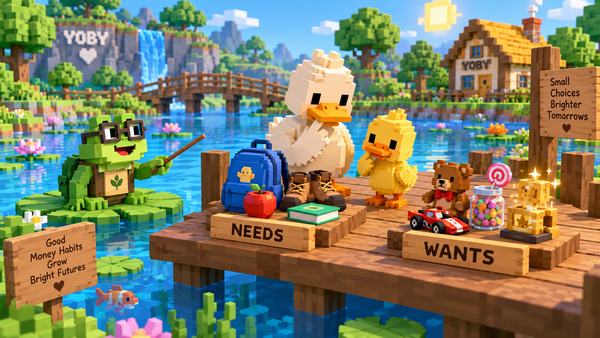
How to Talk About Money with Kids Without Turning It Into a Lesson
Talking about money with kids doesn’t need to feel like a lesson. Everyday choices, small mistakes, shared goals and honest family conversations can help children build healthy financial habits naturally.
Money has a peculiar way of entering family life without ever being formally introduced. It sits on the kitchen counter in the form of a receipt, appears in a hurried conversation about whether this month is more expensive than the last, hides inside the decision to postpone a weekend away, and flashes for a second on a phone screen when somebody pays for dinner. Children notice all of this. They may not understand the numbers, but they understand the atmosphere. They know when a purchase feels easy and when it produces hesitation. They know that some things can be bought today and others have to wait. They know that adults sometimes become quieter when money is mentioned. Long before anyone decides to begin teaching kids about money, children are already assembling their own private theory of what money is, what it does and whether it is something that can be spoken about comfortably.
That is why how to talk to kids about money is a more important question than it first appears. It is tempting to imagine financial education beginning when a parent sits a child down and announces that today they are going to learn about saving. In reality, that sentence may be the least interesting part of the entire process. Children learn far more from the thousands of small decisions that surround them: whether an adult compares two prices, whether a purchase is postponed without drama, whether a mistake can be admitted, whether wanting something is treated as an emergency, and whether money is spoken about as a tool or as a mysterious force that governs the household from behind a locked door. The challenge is not to add more financial lectures to family life. It is to let children see a little more clearly what is already happening.
Children hear the silence too
Families do not need to discuss every financial detail with children, and there are good reasons to protect them from worries they are not old enough to carry. But secrecy and protection are not the same thing. When money is never discussed at all, children are left to interpret the fragments themselves. They may conclude that money is dangerous, embarrassing, endlessly available or somehow unrelated to work, time and choice. A child who sees groceries arrive, holidays happen and subscriptions renew without ever seeing the decisions behind them can easily grow up thinking that adulthood comes with a magical card that makes things appear. The card is visible. The reasoning is not.
This is one of the quiet difficulties of financial education at home. Much of adult financial life is invisible. Payments have become almost frictionless: there may be no coins to count, no notes leaving a wallet, sometimes not even a physical card. A finger touches a screen and the transaction disappears into the background. From a child’s point of view, the distance between wanting something and possessing it has become extraordinarily short. That makes conversation more valuable, not because parents need to explain every purchase, but because occasionally making the invisible visible gives children a map of what is happening.
“We could buy this one, but this other one does the same thing and costs less.” “We’re not buying it today because we are saving for something else.” “Let’s see whether we still want it next week.” These are small sentences, almost incidental, but they contain more financial literacy for families than many formal explanations. They reveal that spending is a choice, that waiting is possible, that prices can be compared and that money used in one place cannot be used somewhere else.
Do not wait for the perfect conversation
Parents often postpone money conversations because they imagine there should be a correct age, a prepared explanation or some degree of financial expertise they do not possess. The result is that the conversation keeps moving into the future. There will be a better moment later, perhaps when the child is older, when the family budget is calmer, when the parent has finally learned everything they believe they should already know. But money does not wait for those conditions. Children are already watching.
The easiest way to begin is not to create a special occasion at all. Use the ordinary world. A supermarket aisle can become a conversation about value without anyone naming the concept. A request for a new game can become a conversation about saving. A family outing can include a simple discussion about choosing between two things because doing both would cost more than planned. A forgotten subscription can even become a useful example of how small payments accumulate. There is no need to gather everyone around a table beneath the ominous heading of “family finance”. Often the best money conversations with children happen while something else is happening.
The tone matters more than the setting. If every conversation about money arrives wrapped in warning, children may learn caution but also anxiety. If every request produces a lecture about how expensive life is, they may begin to associate curiosity and desire with guilt. Financial education should help children understand limits without making those limits frightening. “We are choosing not to buy this” communicates something very different from “We can never afford anything.” The first describes a decision. The second can feel like a condition of the universe.
Let them see decisions, not just outcomes
Adults make dozens of tiny financial judgements each week, but children usually encounter only the result. The package arrives. The holiday gets booked. The old phone is replaced. What disappears from view is everything that happened beforehand: the comparison, the delay, the second thought, the decision that something was not worth the price after all. Showing children some of that process is one of the simplest ways of teaching children about money without making them feel they are being taught.
Imagine a parent comparing two pairs of shoes. One is more expensive, but perhaps it will last longer. The cheaper pair might be perfectly adequate. There may be no universally correct answer. That is precisely what makes the situation useful. A child watching the decision can begin to understand that managing money is not merely about finding the smallest number on a price tag. It is about deciding what matters, what will last, what can wait and what is worth paying more for. In other words, value enters the conversation.
These moments also help children discover that financial choices are rarely divided neatly into good and bad. Adults sometimes buy something unnecessary because it brings joy. They sometimes choose convenience even when it costs more. They sometimes save aggressively for one thing and spend freely on another. Healthy financial behaviour is not a life of permanent refusal. It is the ability to make those choices consciously.
Questions are often better than answers
There is a powerful difference between telling a child what they should do and asking what they think will happen. “You should save that money” ends the discussion. “What happens if you spend all of it today?” opens one. “That is too expensive” delivers a verdict. “Do you think it is worth that much?” asks the child to build one.
This shift is important because financial literacy for children is not ultimately about obedience. A child who always follows instructions can still reach adulthood without knowing how to make an independent financial decision. At some point there will be nobody standing beside them saying which purchase is sensible, which subscription should be cancelled or how much of a salary should be saved. The purpose of early financial education is therefore not to manufacture perfect little savers. It is to develop people who can pause, ask themselves useful questions and recognise that a choice has consequences.
Parents can use questions almost anywhere. “If you bought this, what would you have left?” “Would you still want it if you had to wait two weeks?” “Which of these two things matters more to you?” “What would you do differently next time?” None of these questions requires a spreadsheet. They simply invite the child to notice the structure of a decision.
Money mistakes do not need a courtroom
Sooner or later, a child who has some control over money will make a choice an adult considers terrible. This is not a flaw in the system. It may be the system working.
A small financial mistake made at eight, ten or twelve can be extraordinarily cheap education. Perhaps the child spends everything on something that becomes boring almost immediately. Perhaps they abandon a savings goal because temptation wins. Perhaps they pay too much because they were impatient. The adult instinct is often to prevent the mistake, and sometimes that is necessary, but if every consequence is removed then part of the learning disappears with it.
The more useful moment may come afterwards. Not “I told you so”, but “Would you make the same choice again?” That question leaves the dignity of the decision intact while inviting reflection. Children quickly understand regret when it belongs to them. It does not need to be enlarged by adult triumph.
The same principle applies to parents. One of the healthiest things an adult can sometimes say is, “I bought that and I probably shouldn’t have.” Children who only see adults presenting perfect judgement may assume that competent people never make financial mistakes. They do. The difference is that competent people learn from them, recover from them and adjust. Admitting that reality can make family financial education feel far more human.
Talk about saving without worshipping it
Saving is usually one of the first ideas introduced when adults begin teaching kids about money, and for good reason. It introduces patience, goals and the idea that money can be moved through time. But saving becomes much easier to understand when it is connected to something rather than presented as an abstract virtue. “You should save” sounds like a rule. “You are halfway to the thing you want” sounds like progress.
Children need reasons. A jar filling slowly with coins, a simple progress indicator or a goal written somewhere visible can turn saving into a story. The child can see the distance between where they are and where they want to be. More importantly, they can change their mind. Perhaps the original goal stops feeling important halfway through. That too is useful. It teaches that having saved money does not force you to spend it.
There is something almost philosophical hidden inside this small experience. Money that has not been spent remains possibility. A child who learns that early has understood something valuable about financial freedom.
Let children hear that adults have priorities too
There is no need to share the complete family budget with a young child, but it can be helpful for them to understand that adults also choose. Parents do not simply belong to a mysterious class of humans who can buy whatever they want. There are things adults postpone, things they decide are not worth the cost and things they save toward for months or years.
A sentence such as “We’re keeping some money for our holiday, so we’re not buying that this month” carries several lessons without announcing any of them. It shows that adults have goals. It shows that waiting is normal. It shows that saying no to one expense can be connected to saying yes to something else. This is particularly valuable because children often experience limits only when they are imposed on them. Seeing adults live with limits too makes financial decision-making feel less like a rule for children and more like a normal part of life.
Shared goals can make these conversations even more concrete. A family may be saving for a trip, a bicycle, something for the house or simply a day out together. The amount itself matters less than the visibility of the process. A child who sees progress toward a common objective begins to understand that money can organise cooperation, not just consumption.
Do not turn every trip to the supermarket into economics class
There is, of course, a danger in the opposite direction. Once adults realise how many opportunities there are to talk about money, every ordinary moment can become educational material. A child asks for a biscuit and receives a lecture on consumer psychology. A new pair of trainers somehow becomes an introduction to supply and demand. Before long, money is no longer mysterious, but everyone wishes it were.
Children need space to live. Financial education works best when it is woven into experience lightly enough that curiosity survives. Some moments should simply remain moments. Some purchases should simply be enjoyed. Some games should simply be games.
The distinction matters because the aim is not to produce children who think constantly about money. The aim is to help them become adults who can think clearly about money when they need to. Those are very different ambitions.
This is also why play has such an interesting role in financial education for kids. A child navigating limited resources inside a game can experience trade-offs without anyone interrupting to explain the theory. A marketplace can introduce price and negotiation. A goal can introduce saving. A tempting object can create a decision between immediate pleasure and something further away. Financial ideas emerge inside the experience rather than standing outside it with a pointer.
Money is also emotional
Parents sometimes try to teach money as though it were mathematics, but adults know perfectly well that it rarely behaves that way in real life. People spend because they are happy, bored, anxious, generous, tired, impatient or trying to belong. Children experience many of those impulses too, often with greater intensity because they are still learning to recognise them.
Talking about money therefore also means talking about wanting. Why do you want this? Do you think you will still want it tomorrow? Are you interested in the thing itself or because somebody else has it? These are not questions designed to catch children making foolish decisions. They help connect emotion to action.
The skill of noticing an impulse before acting on it may eventually matter more than knowing a hundred financial definitions. A person can understand compound interest perfectly and still spend recklessly because they never learned to pause. The foundations of financial education are often less technical than they look.
Parents do not need to know everything
Perhaps one of the greatest gifts adults can give children when discussing money is permission not to know. Finance is full of uncertainty. Prices change, circumstances change, mistakes happen and even experts disagree. Pretending otherwise makes the subject more intimidating than it needs to be.
“I’m not sure. Let’s find out” is an excellent financial sentence. So is “I used to think differently about this.” So is “We made a mistake.” These words tell children that financial competence is not a state of perfect knowledge but a habit of attention.
That makes financial education at home less hierarchical. Parent and child can sometimes investigate together, compare alternatives together and even discover that they prefer different answers. A child might consider something worth buying that the parent would never choose, and within reasonable boundaries that difference is healthy. Value is personal. Priorities are personal. Financial literacy includes learning to explain your own choices, not simply inheriting someone else’s.
The conversation is the beginning, not the lesson
The most important thing about talking to children about money may be that there does not need to be a beginning at all. No ceremony is required. No child needs to hear that they are now entering the world of personal finance. Money is already present in their world, quietly shaping choices every day. The opportunity is simply to make some of those choices visible, to give children a little room to participate and to allow questions to appear before answers rush in.
Over time, something changes. A child begins to ask whether a purchase is worth it. They hesitate before spending everything. They notice that saving for a goal feels different from simply being told not to spend. They begin comparing options, revising decisions and recognising that money is neither an endless supply nor a source of shame. It becomes what it should have been all along: a tool.
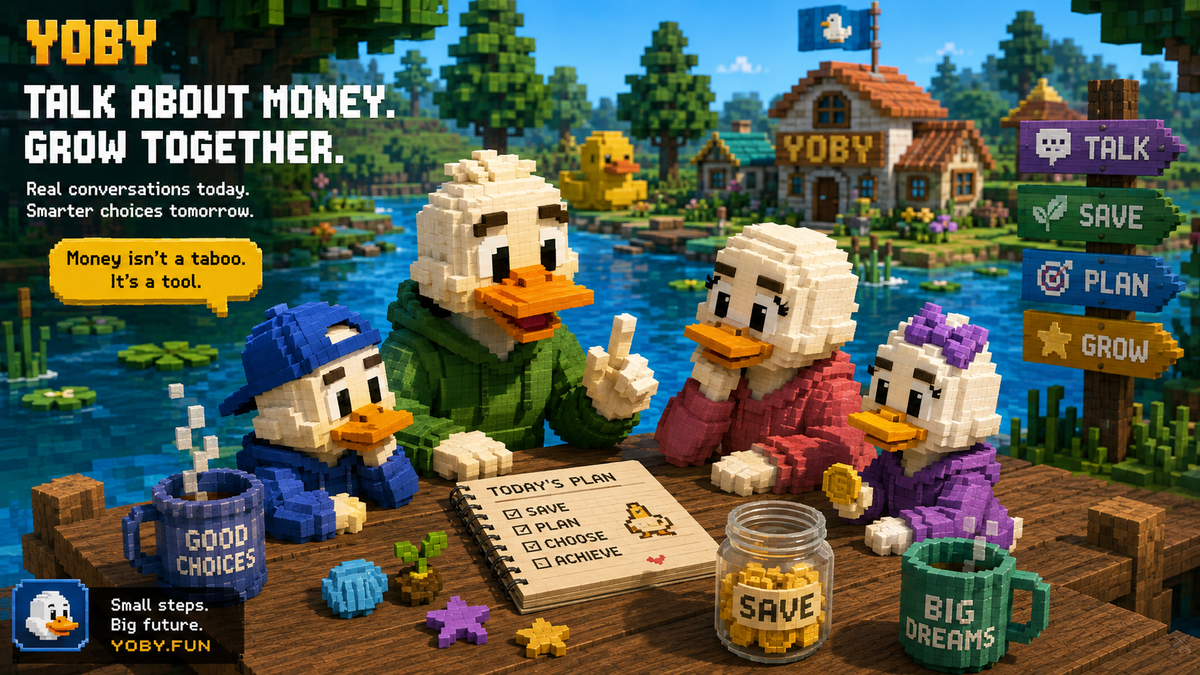
That idea sits at the heart of YOBY, where children and grown-ups explore money through a shared world rather than through another course. The family pond, characters, choices, goals and playful economy are designed around the same principle: learning about money works best when the conversation belongs inside life, not outside it. YOBY’s own approach to families is built around playing and discovering together, with concepts such as saving, goals, patience, choices and value emerging naturally from what happens in the world.
Perhaps the most useful question a parent can ask, then, is not “How do I explain money to my child?” It may simply be: “How can I let them see the choices we are already making?”