Financial Education for Kids: Where to Start
Financial education for kids starts long before bank accounts and budgets. Everyday choices about saving, spending, waiting and value can help children build healthy money habits naturally, without turning finance into another school subject.
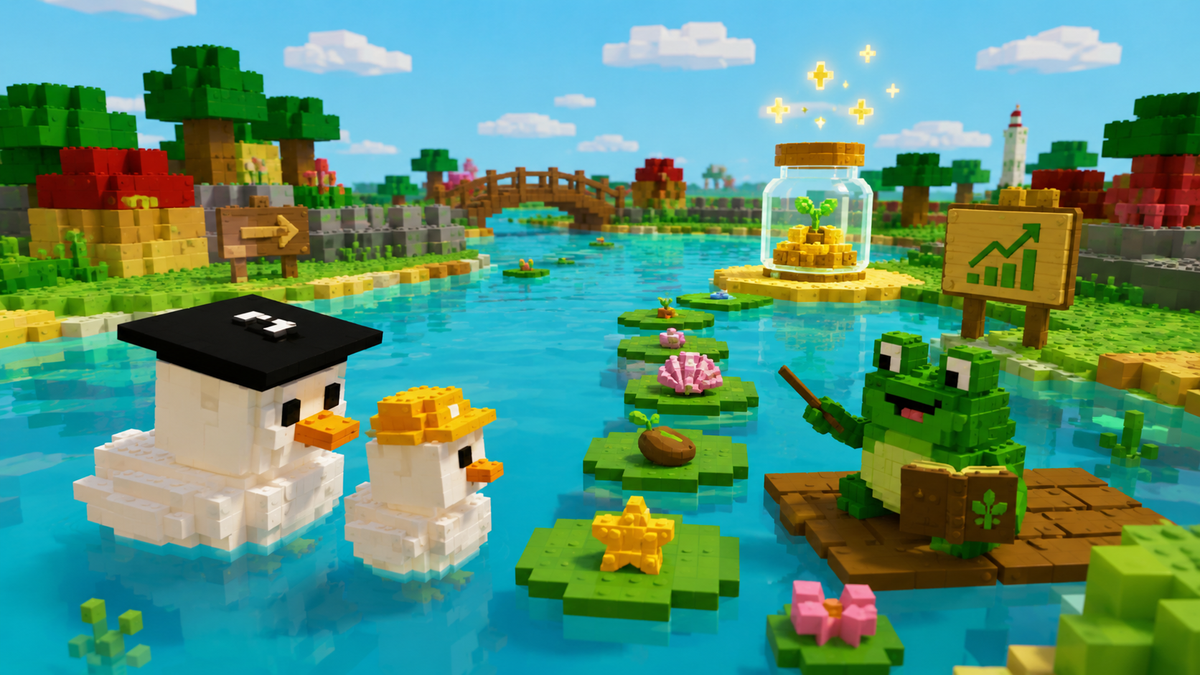
Children begin learning about money long before anyone decides to teach them about it. They watch adults pay for groceries, notice that some purchases happen immediately while others have to wait, hear fragments of conversations about what is expensive and what is affordable, and gradually understand that money creates possibilities but also limits. In that sense, financial education for kids does not really begin with a lesson, a worksheet or a bank account. It begins with observation. Children are already collecting information about money from everyday life, often without adults realising it, and the question is not whether they will form ideas about money, but what kind of ideas they will form. That is why the best place to start is not with technical language about interest rates, inflation or investments, but with situations children can understand directly: choosing between two things, waiting for something they want, saving toward a goal, discovering that spending has consequences, and learning that having money does not mean having to spend it.
Financial literacy starts with everyday decisions
When adults think about financial literacy for children, they often imagine teaching definitions: what a bank is, what saving means, how a budget works. Those concepts will eventually matter, but they make much more sense once children have experienced the ideas behind them. A child who understands that resources are limited, that one choice can exclude another and that waiting may create better possibilities has already begun to understand economics, even if nobody has used that word. If a child has five euros and chooses between buying something small today or keeping the money for something they want more next week, that decision contains several financial concepts at once: scarcity, priorities, delayed gratification and opportunity cost. The child does not need those labels yet. The experience is more important than the terminology because financial education becomes meaningful when money is connected to real decisions rather than presented as an abstract adult subject.
This is also why it is useful to resist the temptation to correct every decision immediately. If a child spends all their pocket money on something trivial and regrets it the next day, the disappointment may teach more than a long explanation about responsible spending. As long as the consequences are small and safe, mistakes are part of learning about money. Adults have decades of accumulated memories about purchases they regretted, subscriptions they forgot, things they saved for and things they bought impulsively. Children do not yet have that internal archive. One purpose of financial education is to let them build it gradually while the stakes are still tiny.
Start with choices, not lectures
A simple financial choice can teach more than a perfectly prepared lesson because it gives the child something to own: the decision. If every purchase is decided by an adult, every mistake prevented and every questionable choice corrected before it happens, children may possess money without ever learning to manage it. Giving them a limited amount of freedom changes that. The goal is not to encourage careless spending, but to create a small territory where decisions belong to them and consequences remain manageable. A child who discovers that three small purchases have consumed the money intended for a larger goal has learned something important about priorities. A child who saves for several weeks, finally reaches the required amount and then decides that the object is no longer worth buying has learned something even more subtle: money that has not been spent still represents possibility.
This is one of the foundations of healthy money habits for kids. Saving should not be taught as a moral virtue and spending should not be treated as a failure. Money exists to be used. The real skill is learning to decide when using it is worthwhile. A healthy relationship with money is not built around fear, guilt or constant restriction, but around awareness. Children gradually learn that they can spend, save, wait, change their minds and compare alternatives, and that each of those actions has consequences.
Saving works better when there is a real goal
“Save your money” is an instruction. “You need fifteen euros for that and you already have six” is a story with a destination. Children usually understand saving much more easily when it is connected to something visible and desirable because the future becomes concrete. The goal does not need to be expensive or important by adult standards. In fact, smaller goals are often better in the beginning because children can experience the entire cycle in a reasonable amount of time: wanting something, setting money aside, watching progress accumulate, resisting smaller temptations and eventually deciding whether the original goal is still worth pursuing.
That final choice matters. Adults sometimes assume that successful saving ends with the purchase, but a child who saves enough money and then chooses not to spend it has learned something extremely valuable. They have discovered that reaching a financial goal does not remove their freedom. The money is still theirs, the choice is still theirs, and they can create a new goal if they want. This is the beginning of understanding that savings are not simply money that cannot be touched. They are stored choices.
Talk about money without turning every conversation into homework
One of the most effective ways to build financial education at home is simply to make ordinary financial reasoning more visible. Children often see only the last step of a transaction: an adult taps a card, a phone or a watch and something becomes theirs. The thinking that happened before that moment is invisible. Parents can expose a little of that process without discussing private financial details or transforming dinner into a seminar. Saying “this one costs less and does the same thing”, “we are waiting until next month because we are saving for something else”, “let’s see how much this subscription costs over a whole year” or “we decided how much we wanted to spend before coming here” gives children access to the logic behind everyday choices.
These small remarks can be far more valuable than formal explanations because they show that money management is not a separate activity reserved for banks and accountants. It is woven into ordinary life. At the supermarket, during a holiday, while choosing a birthday present or deciding whether to replace something that still works, there are opportunities to talk about price, value, priorities and alternatives. Children do not need to participate in every financial decision the family makes, but seeing some of the reasoning helps remove the mystery surrounding money and makes future conversations much easier.
Pocket money can be a laboratory for real life
Pocket money is often discussed in terms of the correct amount or the correct age, but its educational value depends much more on what children are allowed to do with it. A small amount of money can become a remarkably useful laboratory because it allows children to experiment with real decisions while the consequences remain limited. Spending everything too quickly can be frustrating, but safe. Saving toward something and then regretting the purchase can be disappointing, but memorable. Choosing to wait can create a sense of achievement that no explanation of delayed gratification could reproduce quite as effectively.
This is why pocket money works best when it includes some genuine autonomy. If a child receives money but every purchase still requires adult approval, the educational experience is incomplete. Parents naturally need boundaries, especially depending on age, but within those boundaries there should be room for choice. The purpose is not merely to give children money to spend. It is to give them a small amount of decision-making power and let them discover that managing money means managing trade-offs.
Teach value, not just price
One of the most important ideas in financial education for children is that price and value are not the same thing. Something expensive is not automatically valuable, and something cheap is not automatically a good purchase. Children encounter this difference constantly. A collectible can be extremely important to one child and completely meaningless to another. A toy bought impulsively may be forgotten within two days, while an inexpensive object used every day may provide much more value. Two products can do the same job but cost very different amounts, and the more expensive one is not always the better choice.
Talking about value also helps avoid a simplistic version of financial education in which saving is always praised and spending is always criticised. Good money management is not about refusing to spend. It is about understanding what you receive in exchange for your money and deciding whether that exchange is worth it. This makes conversations about money less moralistic and more practical. Instead of asking “Was that a good or bad purchase?”, parents can ask “Was it worth what you paid?” or “Would you make the same choice again?” Those questions invite reflection without turning every decision into a judgement.
Needs, wants and priorities
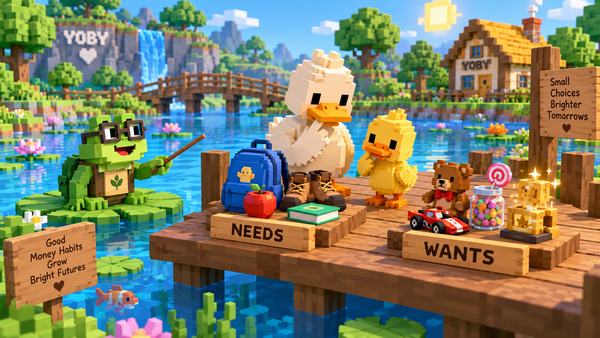
The distinction between needs and wants is one of the classic starting points for teaching kids about money, and it is useful, but reality becomes more interesting when children discover that the categories are not always perfectly clean. Food is a need and a toy is a want, but many real-world decisions live somewhere between those extremes. Clothes are necessary, but not every pair of shoes is equally necessary. A phone may be optional for one family and important for another. A birthday present is not essential for survival, yet relationships and social life have value too.
Instead of asking children only to classify everything into two boxes, it can be more useful to talk about priorities. Why does this matter to you? What would you choose if you could have only one of these things? Would you still want it if you had to save for it yourself? What would you give up to get it? These questions introduce one of the deepest ideas in personal finance without requiring any technical explanation: money management is ultimately about deciding what matters most when resources are limited.
Financial education should feel like life, not another school subject
Children already spend a large part of their lives being taught, assessed and corrected. Turning every financial concept into another lesson risks making money feel distant and tedious before they have even had the chance to explore it. Play, stories, simulations and everyday situations offer a different route. A pretend shop teaches exchange and pricing. A game with limited resources teaches scarcity. Saving toward an in-game goal introduces delayed gratification. Negotiating with another player introduces perceived value. Choosing between two rewards introduces opportunity cost. The language can come later because the mental model is already forming.
This is why financial literacy games for kids can work particularly well when the financial concepts are embedded in the experience rather than presented as facts to memorise. Children do not necessarily need someone to explain that resources are finite after they have had to decide how to use them. They have felt the problem themselves. When learning happens through consequences and choices, the concept becomes part of a story rather than another definition to remember.
Parents do not need to be financial experts
Many parents hesitate to talk about money because they do not feel particularly knowledgeable themselves. They may have made mistakes, struggle with budgeting or simply feel that finance is not their subject. None of that prevents them from helping their children build healthier habits. In fact, some of the best conversations begin with uncertainty: “I don’t know, let’s work it out”, “Which option do you think makes more sense?”, “What do you think would happen if we spent everything?”, “Would you still want this if you had to save for it yourself?”
These questions are valuable because they make financial education collaborative. The parent does not need to stand at the front of an imaginary classroom with all the answers. Parents and children can reason together. They can compare choices, discuss mistakes and sometimes disagree. That also reflects real life, because good financial decisions rarely have one universal answer. Different families have different incomes, priorities, goals and circumstances. What matters is learning to think before choosing.
When should financial education start?
There is no single perfect age because children develop differently, but the basic principles can begin as soon as a child understands exchange and choice. Younger children can grasp that money is limited and that buying one thing may mean not buying another. As they grow, they can begin setting small savings goals, managing pocket money, comparing prices and thinking about value. Later, those same ideas can expand naturally toward budgets, digital payments, subscriptions, borrowing, interest and eventually investing.
The important thing is that financial literacy for kids should grow with the child rather than arrive all at once as a large package of information. The first objective is not to create a ten-year-old financial analyst. It is to help create a future adult who does not experience money as something mysterious, frightening or completely outside their control.
The best place to start is today
You do not need a curriculum to begin. The next visit to a shop can become a conversation about price and value. The next request for a toy can become a savings goal. The next small amount of pocket money can become an opportunity to make an independent decision. The next family plan can become a way to explain why spending on one thing sometimes means waiting for another. These small experiences accumulate quietly, and over time children begin connecting money with choices, consequences, patience, priorities and goals.
That is also the idea behind YOBY, a playful digital world built around financial education for kids and families. Instead of turning money into another school subject, YOBY lets children and parents explore financial choices through characters, missions, goals, shared experiences and a family world designed around learning by doing. Families can discover more on YOBY for Families.
The first financial lesson does not need to begin with “today we are going to learn about money”. It can begin with a much simpler question: what do you want to do with what you have?