How to Teach Kids to Save Money Without Making Saving Feel Like Sacrifice
Teaching kids to save money works best when saving feels like possibility, not punishment. Goals, visible progress, small temptations and the freedom to change course can help children build patient, healthy money habits.
How to Teach Kids to Save Money Without Making Saving Feel Like Sacrifice
For a child, saving can sound suspiciously like losing. An adult says, “Don’t spend it yet,” and what the child hears is that something desirable has moved further away. The toy is still on the shelf, the game is still unavailable, the sweets are still behind the counter, and the money that could have changed that situation has been told to sit quietly and do nothing. Adults know that saved money is not idle. It is gathering possibility. It is keeping doors open. It is buying time. But children do not arrive in the world with that intuition already installed. They have to discover it, and the way we present saving can determine whether it feels like freedom or punishment.
This is why teaching kids to save money should begin with meaning, not restraint. “You should save because saving is good” is too thin. “If you keep some of this, you can choose something bigger later” gives the child a future they can see. The difference is small in language and enormous in experience. One version asks for obedience. The other introduces possibility.
Saving begins when tomorrow becomes visible
Children live very close to the present. This is not a flaw. It is one of the defining qualities of childhood. A week can feel enormous, a month almost geological, and next year belongs to another civilisation entirely. When adults talk about saving for the future, they are often imagining a future that children cannot yet feel.
The first task is therefore to make tomorrow concrete.
A child may not care about the abstract idea of building savings, but they can care deeply about reaching a specific goal. A bicycle, a game, a book, a model, a trip, a costume, a collectible or something adults cannot fully understand can all do the same job. Once the goal exists, saving stops being money withheld from the present and becomes movement toward something.
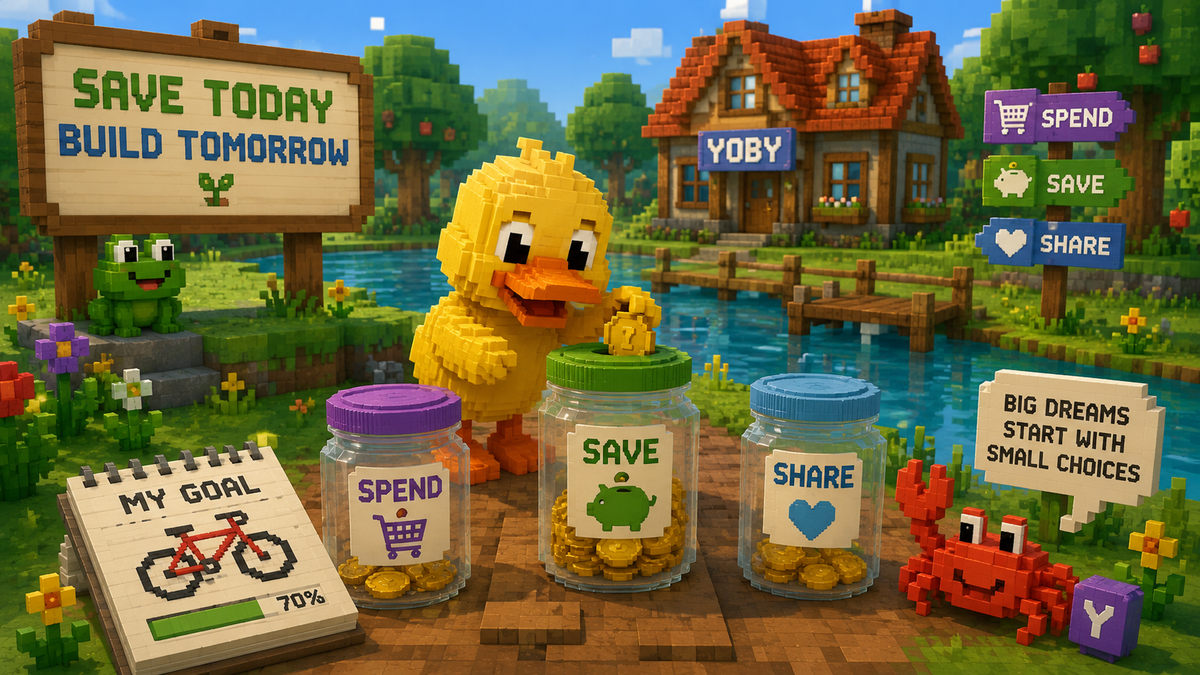
That movement needs to be visible. A jar slowly filling, a simple progress bar, a drawing coloured in section by section, a row of coins becoming longer, a digital goal inching closer to completion. These devices work because they transform waiting into progress. The child is no longer merely not spending. They are getting somewhere.
This is one of the simplest ways to explain saving money for kids. It is not about doing without for the sake of doing without. It is about deciding that one future possibility matters enough to protect from smaller temptations today.
Do not begin by making spending the enemy
One of the quickest ways to make saving feel like sacrifice is to treat spending as a moral failure. Children notice this tone immediately. If saving is always praised and spending is always questioned, money begins to divide into good behaviour and bad behaviour. The child who keeps every coin becomes responsible. The child who buys something becomes reckless.
Real financial life does not work that way.
Money is meant to move. We earn it, save it, spend it, give it away, invest it, waste some of it, recover, make better choices and occasionally repeat the same mistake anyway. A child needs to learn that spending can be thoughtful, joyful and entirely appropriate. The educational goal is not to produce someone who never wants anything. It is to help them notice when one desire is competing with another.
A child saving for a larger goal may still decide to spend part of their money on something small today. That choice is not necessarily wrong. It simply changes the timeline. If the child understands that connection, the lesson is already happening.
This is where healthy money habits for children begin to separate from simple rule-following. A habit is stronger when the child understands why it exists.
Give saving a story
Numbers are useful, but stories are often more powerful.
Imagine a child who wants a skateboard costing forty euros. The child has ten. There are thirty euros missing, which is mathematically obvious and emotionally meaningless. But if the child receives five euros each week and chooses to save most of it, the goal is now connected to time. Six weeks, perhaps less if birthday money appears, perhaps more if another temptation wins.
The skateboard becomes part of a narrative.
Week one: still far away. Week two: something has changed. Week three: the child can almost imagine having it. Week four: a new game appears and the decision suddenly becomes difficult. Week five: perhaps the skateboard is no longer the most important thing. Week six: maybe the goal is reached, or maybe the story has taken another direction entirely.
Saving becomes interesting when it is allowed to have tension.
That tension matters because how to teach children to save money is really a question about decision-making over time. The child is learning that today and tomorrow are connected, and that choices made now change what becomes possible later.
Let goals belong to the child
Adults are not always very good at recognising what is valuable to children. We tend to prefer educational purchases, durable objects and things that seem sensible. Children may care passionately about a small plastic object, a virtual item, a costume accessory or something connected to a world we barely understand.
If the purpose is to teach saving, the goal needs to matter to the child more than it needs to impress the adult.
A savings goal chosen by a parent can feel like an assignment. A goal chosen by the child creates ownership. The child must want the future enough for the waiting to mean something.
This also means allowing goals to change.
A child may save toward one thing for several weeks and then decide they want something else. Adults can feel frustrated by this because consistency looks virtuous from our side of the table. But changing a goal does not erase the learning. The child has already practised waiting, accumulation and delayed spending. The saved money still exists. It has simply become available for a new decision.
The freedom to change course may be one of the deepest lessons saving can teach.
Small temptations are part of the process
No savings goal exists in a vacuum. The world is full of attractive interruptions.
A child saving for something large will encounter sweets, toys, games, school trips, gifts and the occasional object that suddenly appears to be more important than anything previously imagined. Adults often see these interruptions as threats to the lesson. In reality, they are the lesson.
Saving without temptation is easy. Saving when there are alternatives is what makes the process meaningful.
The child may decide to spend. If so, the goal moves further away. That consequence should usually be allowed to remain visible. If the child spends five euros and the parent quietly replaces them, the relationship between choice and outcome disappears.
There is no need for punishment. Arithmetic is enough.
The money was used somewhere else. The goal takes longer. That is the entire lesson.
Over time, kids saving money begin to understand that every purchase has a hidden second price: what it delays, reduces or replaces.
A saved coin should still feel like it belongs to the child
Another common problem appears when saved money becomes untouchable. A child places money in a savings jar, and from that moment the adults treat it as sacred. The child asks to use some of it and is told, “No, that’s your savings.”
There are situations where rules make sense, but if saving always removes control, it can start to feel like confiscation with better branding.
Savings still belong to the child.
They should understand the consequence of withdrawing money from a goal, but the decision should not automatically disappear from their hands. “If you take five euros out, you’ll need another week to reach your goal” teaches more than “You’re not allowed.”
This distinction matters because financial literacy is ultimately about learning to manage resources, not merely learning to obey categories created by someone else.
Use more than one destination for money
As children grow, it can be useful to introduce the idea that money can have several jobs at once.
A simple system might divide money into spending, saving and sharing. It does not need complicated percentages. The child can choose how much goes where, at least within reasonable boundaries. The point is to reveal that money does not always need one single destiny.
Some can be available now. Some can be protected for later. Some can be used for another person.
This is a surprisingly important step in financial education for kids because it moves beyond the binary choice between saving everything and spending everything. Real financial life is usually about allocation. Adults divide income between needs, goals, pleasures, obligations and generosity. Children can begin understanding the same structure in miniature.
The scale is tiny. The idea is not.
Waiting is easier when progress can be touched
If children cannot see progress, waiting can feel empty. That is why tangible or visual systems work so well.
A transparent jar can be surprisingly powerful. The child sees the coins accumulate. A chart on the wall can do the same. Digital systems can work too, provided they show movement clearly rather than hiding everything behind abstract balances.
The progress itself becomes rewarding.
This is important because saving needs an emotional reward before the final purchase arrives. If the only positive moment happens at the very end, younger children may find the process too distant. Seeing the goal move from 20 percent to 30 percent to 50 percent provides smaller moments of satisfaction along the way.
Adults experience something similar when watching a savings account grow. The numbers provide reassurance. For children, the visual language simply needs to be closer to their world.
Do not rescue every savings plan
There will be occasions when a child has almost reached a goal and lacks only a small amount. The adult temptation to help is strong.
Sometimes helping is fine. Gifts exist. Generosity exists. Family life does not need to become a rigid economic simulation.
But if every goal ends with an adult covering the final gap, the child may begin to learn that saving gets you close and someone else completes the journey.
Occasionally waiting one more week matters.
The child discovers that persistence changes the outcome. The last few coins often feel more valuable than the first ones because they complete the story.
And when the child finally reaches the amount, there is something very different about the purchase. The object is no longer simply acquired. It has history.
Sometimes the best ending is not buying anything
One of the most interesting outcomes of a savings goal is that the child may reach it and then hesitate.
The money is there. The thing can finally be bought. Yet the desire is not as strong as it was weeks ago.
This moment should not be rushed.
It contains an extraordinary lesson: waiting creates information. An impulse that survives several weeks may be meaningful. One that fades has saved the child from spending without requiring an adult to forbid anything.
A child who decides not to make the purchase after saving for it has discovered something subtle about money. Having enough is not the same as needing to spend.
The saved amount remains available. A new goal can begin. The possibility has not disappeared.
Talk about saving through your own choices
Children learn a great deal when they see adults waiting too.
“We’re keeping some money for our holiday, so we’re not buying that today.” “I want a new phone, but this one still works.” “We could get the more expensive version, but I don’t think it’s worth the difference.”
These small remarks normalise saving.
They show that waiting is not a rule adults impose on children while exempting themselves. Everyone has limits. Everyone chooses. Everyone sometimes prefers a future possibility to an immediate purchase.
This is particularly valuable in financial education at home because it turns saving into part of family life rather than a lesson directed downward.
Children do not need access to the full household budget. They only need occasional glimpses of the reasoning behind adult decisions.
Let saving remain playful
There is no reason saving has to be solemn.
A child can name a savings jar. A goal can become a little adventure. Progress can unlock something symbolic along the way. Families can celebrate milestones. A game can create long-term objectives that require patience, or offer competing uses for limited resources.
Play does something useful here because it allows children to experience delayed gratification without hearing the phrase “delayed gratification.”
A child who chooses not to spend all their game resources because something important lies ahead is already practising the mental structure of saving. The context may be fictional, but the decision is real.
This is one of the reasons financial literacy games for kids can complement everyday family experience. They allow repeated encounters with choice, scarcity and waiting in a world where the consequences remain safe.
Saving should make the future larger, not the present smaller
At its worst, saving is presented as permanent denial. Do not buy. Do not spend. Do not enjoy this because something responsible might happen later.
Children deserve a better introduction.
Saving is not the art of making life smaller. It is the art of carrying some of today’s possibilities forward.
That framing matters. A child who learns that saving means deprivation may abandon the habit the moment adult supervision disappears. A child who learns that saving creates options may return to it willingly because the benefit belongs to them.
The language around money shapes the emotional relationship with it.
The habit grows from repetition
No single savings goal will transform a child into a lifelong saver. The point is repetition.
A small goal is reached. Another begins. Sometimes money is spent early. Sometimes the child waits. Sometimes the goal changes halfway through. Each cycle adds experience.
Gradually, the child begins to recognise the feeling of wanting something now and wanting something else later. They learn that the conflict does not need to be solved instantly. They can pause.
That pause is a remarkable skill.
Adults often describe financial literacy through knowledge, but much of personal finance depends on the ability to create a little space between desire and action.
Children can begin practising that years before they understand interest rates, credit or investment.
What saving is really teaching
At first glance, saving appears to be about keeping money. Underneath, it is teaching something much larger.
It teaches that the future exists and can be influenced. It teaches that small actions accumulate. It teaches that choosing one thing may mean waiting for another. It teaches that desires can change and that changing your mind is allowed. It teaches patience without requiring passivity, because progress is happening even while nothing is being purchased.
Most importantly, it teaches that money not spent today has not vanished.
It remains potential.
At YOBY, that idea is woven into the way children and grown-ups explore financial choices together. Goals, symbolic currencies, missions and the shared family world are designed to make progress visible and allow children to encounter saving as part of play rather than as another rule delivered by adults. Families can explore that approach through YOBY for Families, where financial concepts such as saving, patience, value and choice live inside a world built to be experienced together.
Teaching a child to save money is therefore not about teaching them to say no to the present. It is about helping them discover that sometimes the most interesting thing money can do is wait.