July 2026: The Month YOBY Became a World
YOBY was born on 3 July. In less than a month, an idea about financial education became a multiplayer world with family ponds, talking characters, an underground realm, school tools, pilot families, international outreach and its first institutional conversations.
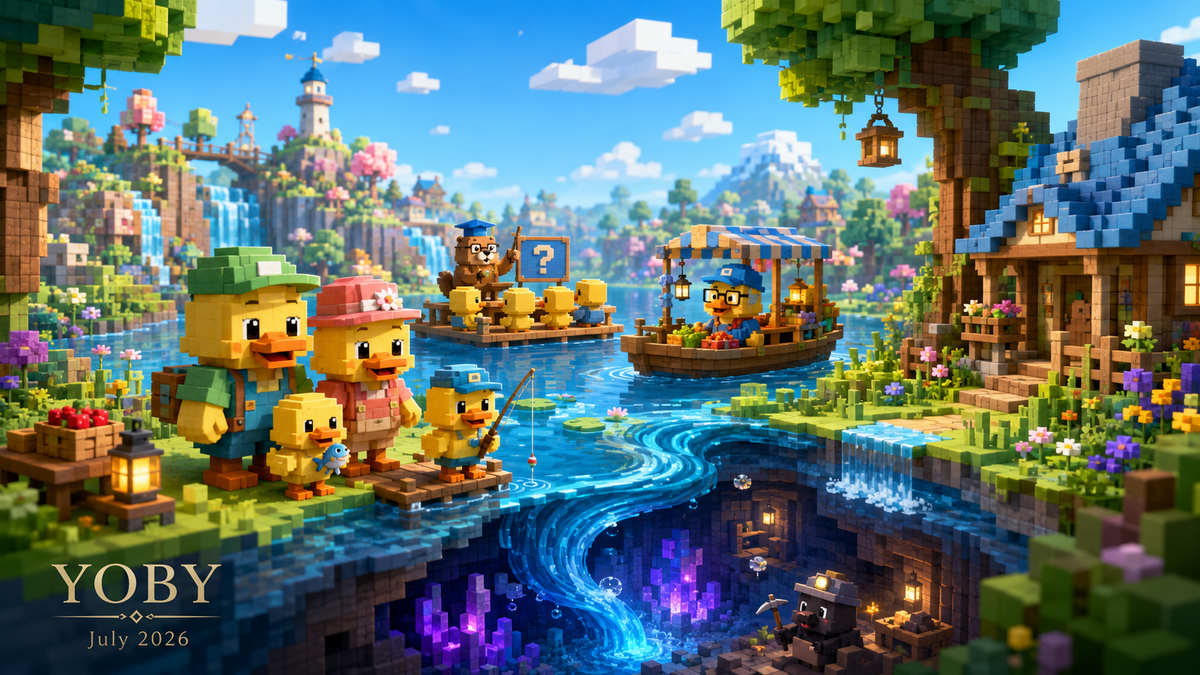
YOBY was born on 3 July. In less than a month, an idea about financial education became a multiplayer world with family ponds, talking characters, an underground realm, school tools, pilot families, international outreach and its first institutional conversations.
When YOBY officially came to life on 3 July, there was no long ceremonial beginning, no comfortable period in which to arrange the furniture and admire the logo from several strategic angles. There was an idea, a small team and a rather ambitious question: could children learn how money works without being placed in front of another lesson, another spreadsheet or another adult explaining what they ought to do? We believed they could, provided that financial education became part of a world worth exploring, where saving, waiting, choosing, negotiating and planning were woven into adventures rather than presented as instructions. The original vision was a shared family pond inhabited by personal ducks, helpful characters and small daily experiences capable of turning money from a family taboo into an ordinary conversation.
That was the theory. July was the month in which we attempted the much more difficult trick of making it real.
By the end of those first twenty-eight days, YOBY had grown into a functioning three-dimensional world with connected ponds, flowing streams, multiplayer exploration, private family spaces, conversational characters, voice interaction, missions, markets, collections and a hidden underground realm. At the same time, we built the foundations for families, teachers and schools to use it safely, connected the game to the public website and membership system, translated the experience into more languages, prepared international school outreach, submitted our first competition applications and began speaking with the people who will help us discover what YOBY must become next. It was not a conventional first month, unless one considers building a small duck-inhabited universe conventional startup behaviour.
Building a place, not another educational app
From the beginning, we resisted the temptation to make YOBY look like a traditional financial product wearing a colourful costume. The intention was never to hide a course behind a cartoon duck or to turn a budgeting dashboard into something children would tolerate for ten minutes. We wanted the environment itself to teach. A path could introduce the idea of choice, a collectible could create a reason to wait, a market could demonstrate that value changes, and a family pond could make shared goals visible without transforming family life into a monthly accounting meeting. The website expresses the same principle directly: YOBY is not a course, but a world in which choices, characters and exploration make ideas about money tangible.
The first version of that world was built around a network of lakes connected by streams. The streams were important because they changed the feeling of the environment from a collection of separate scenes into a landscape with continuity. Children could follow the water, recognise routes and understand that each pond belonged to a larger geography. Into that geography came the voxel ducks, each with its own character and movement, capable of travelling naturally rather than sliding obediently along predetermined lines. We developed navigation systems that allowed characters to find their way through the environment, avoid obstacles and move convincingly across the areas in which they were allowed to travel.
The world also became multiplayer. Families could enter YOBY together through real-time connections, see one another moving and share the same environment instead of merely comparing results after the game had finished. Every household received a private family pond, accessible only to the people invited by that family, while guests could be admitted according to carefully defined permissions. This distinction between shared public areas and protected family spaces quickly became one of the structural principles of YOBY. It allowed the world to feel social without turning it into an uncontrolled public playground, particularly important because the experience is being designed for children from the beginning rather than adapted for them later.
As the geography and multiplayer foundations became stable, the ponds acquired inhabitants. Non-player characters appeared around the water, each intended to have a recognisable role, personality and subject rather than functioning as interchangeable help buttons. Their conversations are supported by language models, but the aim is not to impress children with artificial intelligence. The aim is to make the interaction feel natural enough that the technology disappears behind the character. A child can approach an inhabitant of the world, ask a question, receive an appropriate answer and continue exploring without having to understand that several different systems have just cooperated behind the curtain.
We added text-to-speech so that conversations did not have to remain trapped inside a display. Characters can listen, answer with a voice and display their words through visible speech bubbles, making the exchange easier to follow and more suitable for younger players. Each pond also gained its own soundtrack, giving different areas a distinct atmosphere and allowing the environment to communicate through sound as well as scenery. Some places feel lively, others calmer or more mysterious, and those differences help children remember where they are without requiring another layer of instructions.
Video communication was integrated through Janus, allowing families to meet inside the experience when appropriate. This was not treated as an ordinary social feature that should simply be switched on for everyone. YOBY’s safety model requires adult presence and controlled access, so video communication is designed around family permissions rather than open contact. The broader philosophy is that children should not be expected to manage risks that can instead be removed by the architecture of the product. The public description of YOBY therefore emphasises invite-only family spaces, parental control and the absence of unrestricted child videochat.
Giving the world a purpose
A beautiful pond can attract attention, but it cannot sustain a meaningful learning experience by scenery alone. During July, we began building the systems that give exploration a reason and allow financial ideas to emerge through action. Missions were introduced as short activities connected to characters and locations. Rather than asking children to read a theoretical explanation and then prove they remembered it, missions invite them to make choices, move through the world and see consequences appear around them.
The first game economy also took shape. Players have a pocket for what they can use immediately, a bank for what they decide to keep and opportunities to upgrade parts of their experience. These systems are deliberately symbolic rather than connected to real money. Their purpose is to make the distinction between spending, saving and planning visible through the behaviour of the world. When something is placed in the bank, delayed for a future objective or used for an upgrade, the choice has a consequence that can be seen rather than merely described.
Collectibles and fragments were scattered through the streams and different areas of the map. On the surface, they give children something enjoyable to discover, complete and compare. Underneath, they introduce patience, incomplete goals and the difference between immediately available rewards and collections that require time. A fragment has little value alone, but several fragments can become something larger, which is a far more natural introduction to accumulation than a paragraph defining compound behaviour in abstract terms.
Loris also opened his floating emporium, the Tuesday market that arrives by boat and transforms basic economic ideas into a social event. Children can buy, sell and negotiate within the game economy, encountering the practical questions that accompany every market: whether something is worth its price, whether waiting might produce a better opportunity and whether possessing an object is more important than preserving resources for another goal. Loris is not a lecturer with a price list. He is a character whose presence makes the market feel like part of the weekly life of the world.
Seasonal themes were added so that YOBY could change over time rather than remaining permanently fixed in a single visual moment. The first onboarding journey was expanded into a carousel of characters and places, helping new families understand where they had arrived without confronting them with a manual before they could play. Mobile controls gained a virtual joystick and a landscape interface designed for smaller screens, while the game began saving the position of each character so that returning players could continue from where they had stopped. These improvements may appear modest beside multiplayer systems or conversational characters, but they determine whether a world feels inhabited or resets itself like a demonstration every time the browser closes.
Opening the underground
Once the surface world had acquired ponds, paths and inhabitants, we began digging underneath it. The underground realm became YOBY’s first substantial expansion and an early demonstration that the world could grow vertically as well as geographically. Access points, including a whirlpool-like passage, allow players to leave the familiar landscape and enter a darker environment with its own map, structures, routes and visual language. Returning to the surface is part of the same journey, so the underground feels connected to the existing world rather than loaded as an unrelated minigame.
The Mole became the principal guide to this second realm, introducing the transition to a new level of exploration. Underground messages and interfaces were created specifically for the environment so that players could understand where they were, how to move and how to return without the game suddenly becoming a technical puzzle. New inhabitants also appeared, including a Bat perched on a sign, an Axolotl and other creatures suited to the caves and waterways below the ponds. Each addition helped establish the underground as a place with its own small ecosystem rather than a darker copy of the surface.
The Badger joined the underground as the host of a second market, extending the economic life of YOBY beyond Loris and the familiar surface ponds. This matters because financial understanding is not built through a single shopkeeper repeating the same interaction. Different markets, places and characters allow the same ideas to appear in changing circumstances, where prices, resources and priorities can behave differently. The underground can therefore explore hidden costs, scarce resources and less obvious choices in ways that would feel out of place in the brighter surface world.
Navigation between public and private areas also became clearer. Signs placed beside streams now use a blue arrow when a route can be followed and a prohibition symbol when the water leads towards a family pond that the current player cannot enter. Instead of allowing children to reach an invisible barrier and wonder whether the game is broken, the environment explains its own rules before the mistake occurs. This is a small example of a broader design principle that guided much of July: when the world can communicate through scenery, there should be no need to interrupt the player with another warning box.
Cameras, movement and the work nobody should notice
A three-dimensional world can contain wonderful ideas and still feel unpleasant if the camera fights the player, the controls are confusing or the device struggles to keep up. A large portion of July was therefore dedicated to the unglamorous but essential task of making YOBY comfortable to inhabit. We introduced multiple camera modes so that players could choose how closely they wanted to follow their duck, then added a first-person perspective after a child asked why the world could not be seen through the character’s own eyes. It was the sort of question adults frequently overlook because they have already accepted the rules of the interface. The child had not, and the game improved because of it.
First-person movement required a different control model, closer to steering the character directly, while the more traditional camera continued to support broader exploration. The joystick was refined for mobile devices, and the minimap arrow was aligned with the direction in which the player was actually looking rather than merely with the abstract orientation of the character. These changes reduced the mental effort needed to understand movement, particularly for children who do not arrive with years of experience navigating conventional three-dimensional games.
The navigation system was rebuilt around a dedicated water grid so that characters could understand streams, shores and valid routes more reliably. This improved ordinary movement and also prepared the world for missions that need to send a character towards a particular place. Clicking a mission can now transport the player to the appropriate location when required, removing the frustration of knowing what to do but being unable to find the correct pond. Tutorial interactions were separated more carefully from cinematic character moments, allowing explanations to remain useful without every encounter feeling like an interruption.
We added recovery systems for the inevitable occasions when exploration becomes too adventurous. A family member remaining underground for too long can be returned to an appropriate family location, while an unstuck function helps players escape from awkward positions without waiting for an administrator. Messages explaining private ponds were rewritten to make access rules clearer, and gentle prompts now appear when a family member is alone and might benefit from inviting someone else. An inactivity logout was also introduced, protecting accounts left open on shared or unattended devices.
Performance received the same sustained attention. YOBY gained graphic presets capable of adapting the experience to different hardware, while shadows, distant chunks and remote characters were adjusted so that less powerful devices did not attempt to render every detail at maximum quality. Pixel density, anti-aliasing and hardware acceleration were handled more intelligently, allowing the game to preserve its appearance without treating a modest mobile device like a workstation. We also upgraded the engine, gaining improvements from the newest version while carefully checking that existing systems continued to behave correctly.
An optional frame-rate overlay was created for testing, along with full-screen screenshot tools that make it easier to document visual problems and share progress. These features are not intended to become part of a child’s everyday experience, but they greatly improve our ability to understand what is happening on different devices. The objective is not to boast about technical measurements. It is to ensure that a child entering YOBY notices the duck, the stream and the next adventure rather than the machinery holding them together.
Building YOBY for schools
During July, YOBY also began changing from a family game with educational possibilities into a platform that schools could genuinely test. Wise Duck arrived as the guide to the school experience, providing a recognisable character through whom teachers and pupils can approach quizzes and classroom activities. The quiz system supports assigned school sessions as well as random practice, allowing children to revise without receiving the same fixed sequence repeatedly.
Secure child links were created so that pupils could enter the appropriate character and activity without navigating adult account systems. The result is a simpler experience for the pupil, although a substantial amount of security and identity management remains quietly active underneath it.
Teachers received a permanent demonstration environment so that they can explore YOBY without repeatedly rebuilding a temporary class. Class links were expanded to handle both the roster and the process through which pupils join. School settings now distinguish between parents, teachers and supervisors, because the person who creates a child’s family account, the person who assigns educational work and the person who oversees an entire institution should not receive identical permissions.
Beaver took his place aboard a quiz-show boat, becoming the host of school activities and giving the educational experience its own visual setting. Camera positions and presentation were adjusted so that answering a question feels more like participating in a friendly television programme than completing an online form. Teachers can use the structure of a quiz, but children encounter Beaver, a boat, a stage and a character who reacts to what happens. The learning content remains serious, while its delivery belongs to the world of YOBY.
Behind these visible elements, we created the beginnings of school auditing and administration. The system can record the relationship between an institution, its supervisors, its teachers and its classes, allowing us to understand how YOBY is being used without exposing children to unnecessary data collection. The school programme is designed to remain completely free for institutions. Families may choose optional paid game levels outside the school experience, but no pupil should ever be required to purchase anything in order to participate in classroom activities.
Families, accounts and the bridge to the website
The family system underwent a substantial reconstruction during the month. Registration now creates the appropriate household and character records, while parents can create multiple characters, rename them and manage the structure of their family inside YOBY. This is more complex than attaching a username to a duck because the game must understand that several people may belong to the same household while retaining separate identities, positions, progress and permissions.
Access to ponds was refined to distinguish between guests, children and other family roles. Some areas can be entered by an invited guest, while others remain limited to members of the household or to child characters participating in a particular activity. Membership levels also became connected to the game, allowing YOBY to understand which parts of the world are available without presenting families with a separate technical account system every time they move from the public website into the game.
GhostCMS, which powers the YOBY website and membership experience, was integrated more deeply with the game. Members created through the website can now be provisioned into the family and character systems, closing the gap between reading about YOBY and entering it. The Ghost theme was adapted to the new identity, deployments were improved and login reminder emails were introduced for people who had begun the process but had not yet returned. These changes turned the website from a brochure placed beside the game into the entrance through which families, teachers and supporters can become part of it.
The broader public site also expanded during July. Pages for families, children, schools, safety, privacy, pricing, investors and the press began to create a coherent explanation of the project. A press kit was assembled, an investors section was added to the footer and the mobile interface was revised for landscape play, where the available space is wider but far less forgiving of oversized buttons and panels.
Seven languages and a European beginning
YOBY began in Europe, and we decided early that multilingual communication could not remain an item reserved for a distant expansion plan. English and Italian were joined by French, Spanish, Portuguese, German and, during July, Dutch. Translating a project of this kind involves far more than replacing individual words. Instructions must remain understandable to children, character dialogue must preserve personality, buttons must fit inside interfaces and school communications must sound as though they were written for the recipient rather than processed through a machine.
The onboarding experience was adapted across these languages, including the character carousel that introduces new players to the world. Website links were localised so that families and teachers arriving from an email could continue in the same language rather than landing abruptly on an English page. Campaign banners also became dynamic, allowing the message shown to a school or family to reflect the country and context from which they arrived.
This multilingual foundation changed the way we thought about YOBY. Europe was no longer a future market to enter after proving the product somewhere else. It became the territory in which the product was being shaped from the start. Every language introduced new questions about age, school structures, terminology and cultural expectations, but it also brought the possibility that children from several countries could eventually inhabit the same world while receiving guidance appropriate to their own families and classrooms.
From codebase to startup
July was not only the month in which we built the product. It was also the month in which we began learning how to present YOBY outside our own team. We prepared and submitted applications to DigithON and QS Reimagine Education, two competitions that required us to explain the project from different perspectives. DigithON asked us to describe the startup’s potential and ambition, while QS Reimagine Education placed greater emphasis on educational innovation and international relevance.
Preparing those applications forced us to turn a rapidly growing collection of ideas and features into a coherent argument. We produced an early pitch video, clarified the problem YOBY is intended to solve and refined the distinction between an educational game, a family environment and a school platform. The process was useful even before any jury considered the submissions because it revealed which parts of our story were immediately understandable and which still depended too heavily on explanations only the development team possessed.
We also began identifying the next opportunities, including startup competitions, EdTech awards and university-linked programmes that could provide visibility, feedback or access to partners. We are not applying simply to accumulate badges for the website. Each credible programme offers a different test of YOBY: whether it can be explained to investors, evaluated by educators, understood by public institutions or compared with international projects that approach learning from entirely different directions.
Our public communication grew alongside this work. We created blog articles, social posts, demonstration materials and presentations for several audiences, including families, schools, potential partners and investors. The challenge was to preserve one recognisable YOBY while changing the emphasis appropriately. A parent needs to understand safety and family value, a teacher needs to understand classroom use, and an investor needs to understand why the same world can become a sustainable European platform. They should not feel as though they are being introduced to three unrelated products.
Pilot families and the first schools that answered
The most valuable progress of the month came from people rather than software. Early families began preparing to test YOBY and help us understand how children and parents behave inside a shared world when no member of the development team is standing nearby to explain what everything means. Pilot families are essential because designers can become blind to their own assumptions with remarkable speed. A button seems obvious when one remembers creating it, a route seems easy when one built the map and a mission seems clear when its purpose has been discussed for several days. Real families remove those illusions quickly and usefully.
We also began a large international outreach effort directed at schools. Contact information was gathered from public educational sources in several countries, then processed through country-specific adapters so that different datasets could be handled consistently. Email templates were localised, links were matched to language versions and campaigns were divided into controlled batches rather than released as a single indiscriminate wave. The objective was not merely to send a large number of messages, but to introduce YOBY responsibly to schools that might genuinely find it relevant.
The first replies began arriving, particularly from French-speaking Belgium, France and Italy. We'll start firsts calls and launch in August.
For a project less than one month old, this response carries a significance that cannot be measured only by the number of pupils involved. It means that a school has looked beyond the early state of the product, understood the educational intention and decided that a serious conversation is worthwhile. It also gives us something no internal roadmap can provide: a real institutional context in which our assumptions about classes, teachers, supervisors, parental communication and child access can be tested.
Schools have begun replying and asking questions, creating the first signs that the problem YOBY addresses is recognised beyond our own experience. Those conversations are still at different stages, and we do not intend to describe every expression of interest as a confirmed pilot. What matters at this point is that educators are engaging with the idea, challenging it and helping us understand what evidence, documentation and safeguards they require before introducing a new digital environment to children.
The machinery behind the invitations
Reaching schools at scale required its own substantial engineering effort. We built a mass-email system capable of handling templates, test messages, controlled batches and language-specific links. The batch limits were gradually increased only after delivery behaviour had been observed, because educational contact lists contain addresses maintained by thousands of independent institutions and inevitably include closed mailboxes, outdated staff records and servers with very different filtering policies.
Address validation was added so that clearly invalid recipients could be removed before sending. The system records results, separates hard failures from temporary ones and makes it possible to improve each national dataset over time. This work is less visible than a new character or underground cave, but it protects the reputation of the YOBY domain and reduces the number of unnecessary messages sent to addresses that no longer exist.
School datasets required specialised harvesting and transformation tools because each country publishes information differently. One source may provide structured files, another a directory of individual pages and another a collection of regional resources that must be combined. Adapters were therefore built to transform these different formats into a consistent internal structure while preserving language, country and school type. Dynamic banners and localised destinations were added so that outreach could lead to an experience appropriate for the recipient rather than a generic international homepage.
We also learned a great deal about the practical side of deliverability, including authentication, bounce management, blocklists and the difference between a technically accepted email and one that reaches a person’s inbox. These lessons were sometimes less charming than designing ducks, but they are part of building a startup that intends to work with real institutions. A wonderful educational idea that never reaches a teacher remains invisible, while an irresponsible outreach system can damage trust before the conversation begins.
Infrastructure, administration and the work beneath the floorboards
Behind the game, website and outreach campaigns, the technical foundation of YOBY was rebuilt repeatedly throughout July. Authentication, household management and multiple-character accounts required a database structure capable of supporting families now and school relationships later. Nginx deployments were configured, databases were maintained and Piper was introduced for local text-to-speech, reducing dependence on external services for voices that may eventually be used frequently throughout the world.
Administrative tools began showing who was online and providing better oversight of school activity. Version badges were added so that problems could be connected to the exact release a player was using, while asset caching was refined to prevent browsers from retaining obsolete files after an update. Anyone who has ever deployed a game inside a web platform knows the peculiar frustration of fixing a problem only to discover that a browser is still faithfully displaying yesterday’s broken version. Better cache control does not appear in a promotional video, but it preserves the sanity of both developers and testers.
Deployment procedures became safer and more repeatable. The game, website, membership system and supporting services no longer behaved like unrelated experiments living on the same server. They began forming a single product with shared identities, coordinated releases and clearer operational boundaries. That integration is important because every new family or school increases the cost of improvisation. A manual workaround that is acceptable for three testers becomes dangerous when applied to hundreds of accounts.
The administrative foundations also support our commitment to child safety and European data protection. YOBY is designed to minimise unnecessary access, separate roles and keep family and school spaces under the control of responsible adults. The goal is not to add a safety page after the product has been completed. Safety must influence how accounts are created, how children join classes, who can enter a pond, when communication tools appear and what information an administrator is allowed to see.
What July changed
At the beginning of July, YOBY was an ambitious idea about using a shared digital world to make financial education more natural for children and families. At the end of July, it had become a functioning product with enough depth to reveal both its potential and its unanswered questions. Families could create households and characters, enter private ponds, explore together, speak with inhabitants, complete missions, manage symbolic resources, discover collectibles, visit markets and travel into an underground realm. Teachers could create classes, share access links and experiment with quizzes hosted by characters rather than forms. The website, membership system and game had begun operating as parts of the same experience.
The month also changed the scale of our thinking. Multilingual communication and international school outreach moved Europe from the final page of a roadmap to the immediate context in which YOBY is being built. Applications to DigithON and QS Reimagine Education required us to explain the project beyond our own enthusiasm, while pilot families and replies from schools began introducing the far more valuable discipline of external reality. The first Belgian and French school conversation is not proof that every assumption is correct, but it is evidence that the question behind YOBY deserves serious attention.
Much of what we built will continue to change. Interfaces will be simplified, characters will acquire stronger personalities, missions will become more sophisticated and some early decisions will almost certainly be replaced as families and teachers show us better alternatives. That does not diminish the work of this first month. Early systems are valuable not because they are permanent, but because they allow real people to enter the idea, react to it and help transform speculation into knowledge.
July therefore cannot be summarised only as a list of completed features, even though the list is unusually long. It was the month in which the different parts of YOBY began reinforcing one another. The family world gave meaning to the account system, the characters gave life to the educational content, the school tools created a path towards institutional use, the translations made international outreach credible and the replies from educators gave urgency to the next phase of development. The product, the infrastructure and the startup story began moving in the same direction.
There is still a great deal to build, test and learn, and we have no intention of pretending that twenty-eight intense days have answered questions that usually take years. What July has given us is something more useful than certainty: a real world that families can enter, a school programme that educators can examine, an international audience beginning to respond and a clear foundation on which August can build. YOBY started on 3 July as an idea about ducks, families and better conversations about money. Before the month ended, that idea had acquired geography, inhabitants, classrooms, markets, languages, infrastructure and its first place in the calendars of people outside our own team.