Pocket Money for Kids: How to Turn It Into a Learning Tool
Pocket money can be much more than spending money. With a little freedom, patience and room for small mistakes, it becomes a powerful way for children to learn saving, choice, value and independence.
There is a small but remarkable moment in childhood when money changes character. Until then it has belonged to adults, appearing briefly at supermarket checkouts, inside birthday cards, on glowing payment screens and in conversations whose meaning is only half understood. Then one day a child is given a few coins or a small regular amount and told, in effect, that this money is theirs. It may not be much, but something fundamental has changed. The child is no longer merely watching other people make financial decisions. For the first time, there is something they can spend, keep, regret spending, forget about, save carefully, lose interest in, or turn into something they have wanted for weeks. Pocket money for kids matters less because of what children can buy with it than because of what becomes possible once a little piece of the financial world belongs to them.
Parents naturally tend to focus on the obvious questions. At what age should pocket money begin? How much should a child receive? Should it be weekly or monthly? Should it be connected to chores? These are reasonable questions, and families will answer them differently, but they can distract from the more interesting one: what do we want pocket money to teach? A child can receive an allowance for years without learning very much if every decision is still made by an adult. Conversely, even a very small amount can become a powerful form of financial education at home if it gives the child genuine choices and enough freedom to experience what those choices mean.
The first important thing pocket money buys is autonomy
Adults often think of pocket money as money for treats, toys or small purchases, but its first real purchase is autonomy. The amount creates a tiny territory in which the child can say, “This is mine, and I decide what happens next.” That territory needs boundaries, of course. Age matters, safety matters and parents do not have to approve every conceivable purchase. Yet within reasonable limits, the educational value comes precisely from allowing decisions to belong to the child.
If a parent gives a child five euros and then determines exactly how every cent should be used, the child has received money but not responsibility. If the child is allowed to decide whether to spend it today, keep it for later or add it to something already saved, the same five euros become something richer. They contain uncertainty. They contain temptation. They contain the possibility of a mistake.
This is where teaching kids about money becomes real. Financial decisions made with someone else’s money and someone else’s judgement remain theoretical. The moment a child has to decide whether a small purchase is worth reducing the amount they have left, arithmetic turns into experience.
Let small mistakes remain small mistakes
A child with pocket money will eventually buy something ridiculous. This should probably be regarded as a feature rather than a crisis.
Perhaps the object breaks before dinner. Perhaps a handful of sweets seemed like an excellent idea until the child remembers the larger thing they had been saving for. Perhaps a toy that looked irresistible in the shop loses its magic before the journey home is over. An adult can often see these disasters approaching from several aisles away, and the instinct to intervene is powerful. We have already lived through our own useless purchases. We know how the story ends.
But if every bad decision is prevented, children lose the chance to discover that particular ending for themselves.
There is a profound difference between hearing “You’ll regret that” and actually regretting it. The first is advice. The second becomes memory. If the amount is small and the consequences are harmless, pocket money creates one of the rare places in childhood where failure can be both genuine and inexpensive. A disappointing two-euro purchase at nine may be worth far more than two euros if the memory resurfaces years later before a much larger impulsive decision.
The parent’s role after such a mistake is not to convene a financial tribunal. “I told you so” adds very little. “Would you make the same choice again?” adds a great deal. It invites the child to examine the experience without having to defend themselves from the adult who predicted it.
Pocket money should not become a test of virtue
There is an easy trap here. Once adults begin seeing pocket money as educational, every decision can start to feel like an examination. Saving becomes the correct answer. Spending becomes suspicious. A child who keeps every coin is praised, while one who spends is treated as though they have misunderstood the assignment.
But money is not designed only to be accumulated.
A child who carefully saves for something they love and then buys it has not failed at saving. They have completed the purpose of it. A child who decides that a small pleasure today matters more than a distant goal may not necessarily be wrong. Financial literacy is not the art of refusing everything. It is the ability to understand that choices compete with one another and to decide consciously which one matters more.
This is why allowance for kids works best when parents resist turning saving into morality. Children should certainly discover the advantages of patience and accumulated money, but they should also discover that spending can be satisfying, generous, useful and joyful. Healthy money habits need both verbs.
The important question is not always “Did you save it?” Sometimes it is simply “Are you happy with what you chose?”
A goal gives saving a direction
Money kept for no reason is difficult for a child to understand. Adults can save for vague future security because we have enough experience to imagine emergencies, retirement and bills that have not yet arrived. Children live closer to the present. The future needs shape.
A savings goal gives it one.
It might be a toy, a game, a book, a trip, something for a hobby or an object whose importance is completely mysterious to every adult in the household. That last category is perfectly acceptable. The goal does not have to make sense to the parent. It has to matter to the child.
Once there is a goal, kids saving money begin to experience progress rather than deprivation. Five euros is no longer simply five euros that cannot be spent. It might be one quarter of the way toward something. Another week changes the picture. A birthday gift changes it again. The child begins to understand that time and repetition can turn small amounts into larger possibilities.
And then something even more interesting may happen. Halfway through, the child may change their mind.
This is not wasted saving. It is one of the most valuable discoveries pocket money can offer. A goal is not a contract. Money already saved can become a new possibility. Children learn that they remain in charge of the decision even after the discipline of saving has done its work.
Weekly or monthly matters less than what the rhythm teaches
Parents searching for advice about how much pocket money to give children often encounter confident formulas, charts and age-based amounts. In practice, family circumstances differ too much for a universal number to be especially useful. What matters is that the amount is small enough for mistakes to remain safe, but meaningful enough for choices to matter.
The rhythm can also evolve with age. A weekly amount keeps the time between decisions short and may work well for younger children. A monthly allowance creates a longer horizon and makes early overspending more visible. If the money disappears in three days, the calendar itself becomes part of the lesson.
That experience should not automatically trigger a rescue payment. An advance every time the money runs out teaches a different financial system: consequences exist until someone replaces them. Sometimes the educational value lies in waiting for the next regular amount to arrive.
This does not need to be harsh. It can simply be factual. The money is gone. The next pocket money arrives on its normal day. Suddenly budgeting is no longer a word. It is Thursday, and Saturday is still two days away.
Should pocket money be tied to chores?
Few questions about pocket money for kids create more disagreement than whether children should earn it through household chores. There is no single arrangement that suits every family because two different ideas are involved. One is that children should learn that money is connected to effort. The other is that members of a family should contribute to ordinary household life without expecting payment for every plate carried to the kitchen.
Both ideas have merit.
Some families separate the two. Regular household responsibilities are simply part of living together, while additional jobs can earn extra money. Washing your own plate might be expected; helping with a larger task beyond normal responsibilities might have a price attached. Other families prefer a straightforward allowance unrelated to chores and introduce earning through other activities.
The important thing is clarity. If every helpful action is monetised, children may begin to ask what the payment is before deciding whether to help. If money always appears without any relationship to effort, they may miss another useful connection. Families can build their own balance between contribution, responsibility and earning without pretending there is one universally correct system.
What matters educationally is that the rules are understandable and stable enough for the child to make decisions around them.
Let the money be visible
Modern money has become wonderfully convenient and strangely invisible. Adults can spend an entire day making purchases without touching a coin or seeing a banknote. For children, that invisibility can make money feel almost fictional. A card is tapped, a phone makes a sound, and the object comes home.
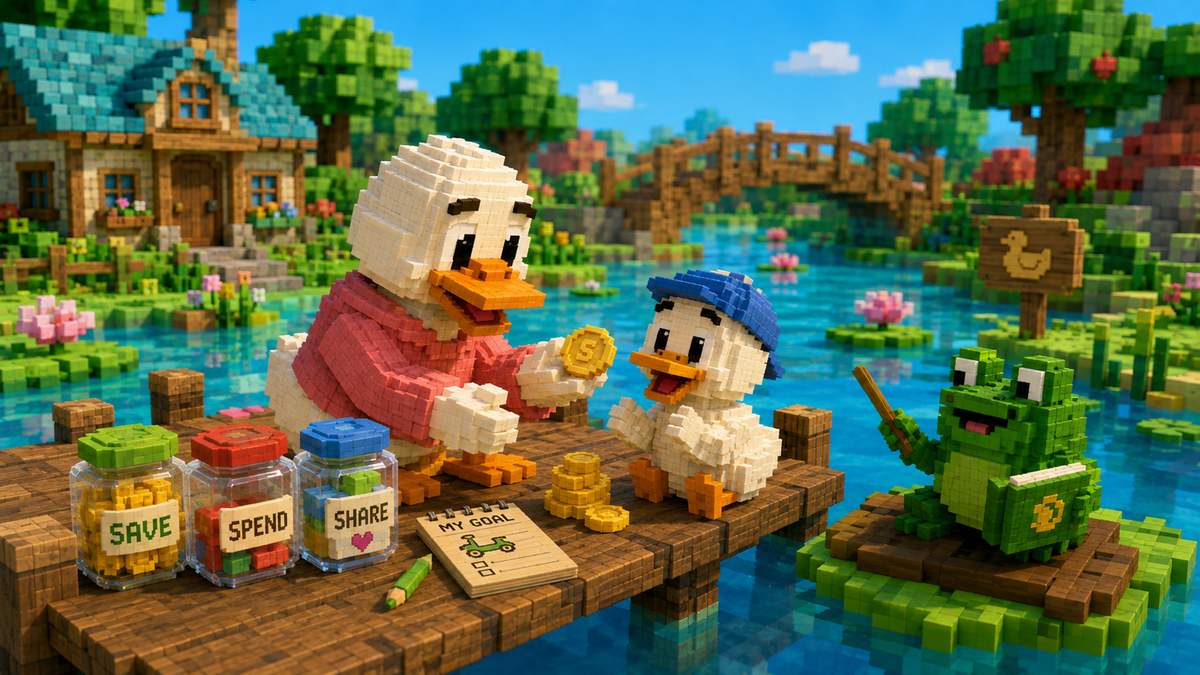
With younger children especially, physical money can make relationships easier to see. A jar that fills slowly, separate envelopes for different purposes or coins counted toward a goal turn abstraction into something tangible. The child can see that spending removes something. Saving adds something. Progress occupies physical space.
Digital tools can later do the same job if they make the process visible rather than merely frictionless. A balance that changes, a goal that progresses or a symbolic representation of saving can help children connect actions with consequences. The important part is not nostalgia for coins. It is visibility.
If money disappears behind interfaces, the educational experience needs another way of bringing it back into view.
Do not replace every loss
There comes a day when the saved amount is almost enough, and something tempting appears. This may be the most interesting moment in the whole experiment.
The child knows the goal. They know how long they have been saving. They also know that the new object is available now. The conflict is genuine because both possibilities have value. Adults encounter the same conflict constantly, only with different numbers and more sophisticated justifications.
If the child chooses the immediate purchase, the savings goal moves further away. That consequence matters. If a parent later quietly replaces the spent amount so the original goal can still be reached on schedule, much of the choice disappears retroactively.
Pocket money works because the arithmetic has memory.
Every euro can only be used once. That simple truth contains the foundations of budgeting, opportunity cost and financial planning. A child does not need those terms. They need the experience of standing between two desirable possibilities and discovering that choosing is unavoidable.
Talk about money, but leave some silence around it
Pocket money gives families many opportunities for conversation, but not every coin needs commentary. Children should sometimes be allowed to manage their small financial world without feeling that an auditor lives in the next room.
A parent can ask questions when they are useful. “Are you still saving for that?” “How much more do you need?” “Was it worth buying?” “What are you thinking of doing with the rest?” These questions make the child’s reasoning visible without immediately replacing it with adult judgement.
Then sometimes the best response is simply to listen.
A child explaining why an apparently absurd object is worth six weeks of saving may reveal an entire system of value that adults would never have guessed. Perhaps it connects to friends, a collection, a game or an idea that matters intensely at that age. Understanding value does not require adults and children to agree about what is valuable.
That disagreement may be part of the education.
Pocket money can introduce generosity too
Financial education is sometimes reduced to a private triangle of earning, spending and saving, but money also moves between people. Children can discover this surprisingly early.
A child may want to buy a small gift for someone else, contribute to something shared or give part of their money to a cause they care about. These decisions introduce another dimension of value. Money can create something for another person rather than only obtain something for oneself.
Parents do not need to impose a compulsory generosity percentage to make this visible. In fact, generosity may be more meaningful when it genuinely belongs to the child. A gift purchased from one’s own limited pocket money feels different from a gift chosen while an adult holds the wallet.
The child has not merely selected an object. They have given up another possible use of their money because somebody else mattered more.
There is financial education inside that decision too.
As children grow, the world can grow with them
Pocket money does not need to remain the same experiment forever. A young child may simply choose between spending and saving. Later, they can manage a longer period, compare prices, plan several goals or take responsibility for particular small expenses. Adolescence eventually introduces an entirely new landscape of digital payments, subscriptions, online purchases, peer pressure and greater independence.
The useful thing about starting early is that the numbers can grow while the underlying ideas remain familiar. The teenager deciding whether a monthly subscription is worth keeping is using the same mental muscles as the child who once chose between a small toy today and a larger one later.
Financial education works best when it is cumulative. Each new layer rests on something already experienced.
The amount is small. The idea is not.
From an adult perspective, a few euros of pocket money may look almost trivial. The numbers barely register beside rent, mortgages, groceries and salaries. But childhood gives those few euros an unusual power because they may be among the first financial resources over which the child has genuine control.
Within that tiny economy, enormous ideas can appear. Scarcity. Choice. Patience. Regret. Planning. Value. Generosity. Independence. The strange satisfaction of seeing a goal move closer one small amount at a time.
That is why pocket money can be much more than a convenient way for children to buy sweets. Used with a little freedom and a little patience from the adults around them, it becomes a safe rehearsal for decisions that will one day involve much larger numbers.
At YOBY, we approach financial education for kids and families from the same direction. Children do not need another place where adults explain money to them from the outside. They need places where choices become visible, where goals take time, where resources can be used in different ways and where a small decision can change what becomes possible next. In the YOBY world, families can explore those ideas together through play, shared goals and everyday financial choices rather than treating money as another subject to memorise. Families can discover more about that approach through YOBY for Families.
The first pocket money a child receives may buy something forgettable. That hardly matters. What lasts is the discovery hidden behind it: this is mine, I have choices, and what I choose changes what happens next.